Skip to content
Solutions

How to build a shift coverage plan managers can trust

A coverage plan spells out your operating hours, minimum staffing, required skills, peak periods, break and handoff cover, absence backup, and review rules. Done well, it answers two questions on any given day: who has to be working right now, and what happens the moment that falls below the minimum.

  • Operating hours and service windows
  • Minimum people per time block
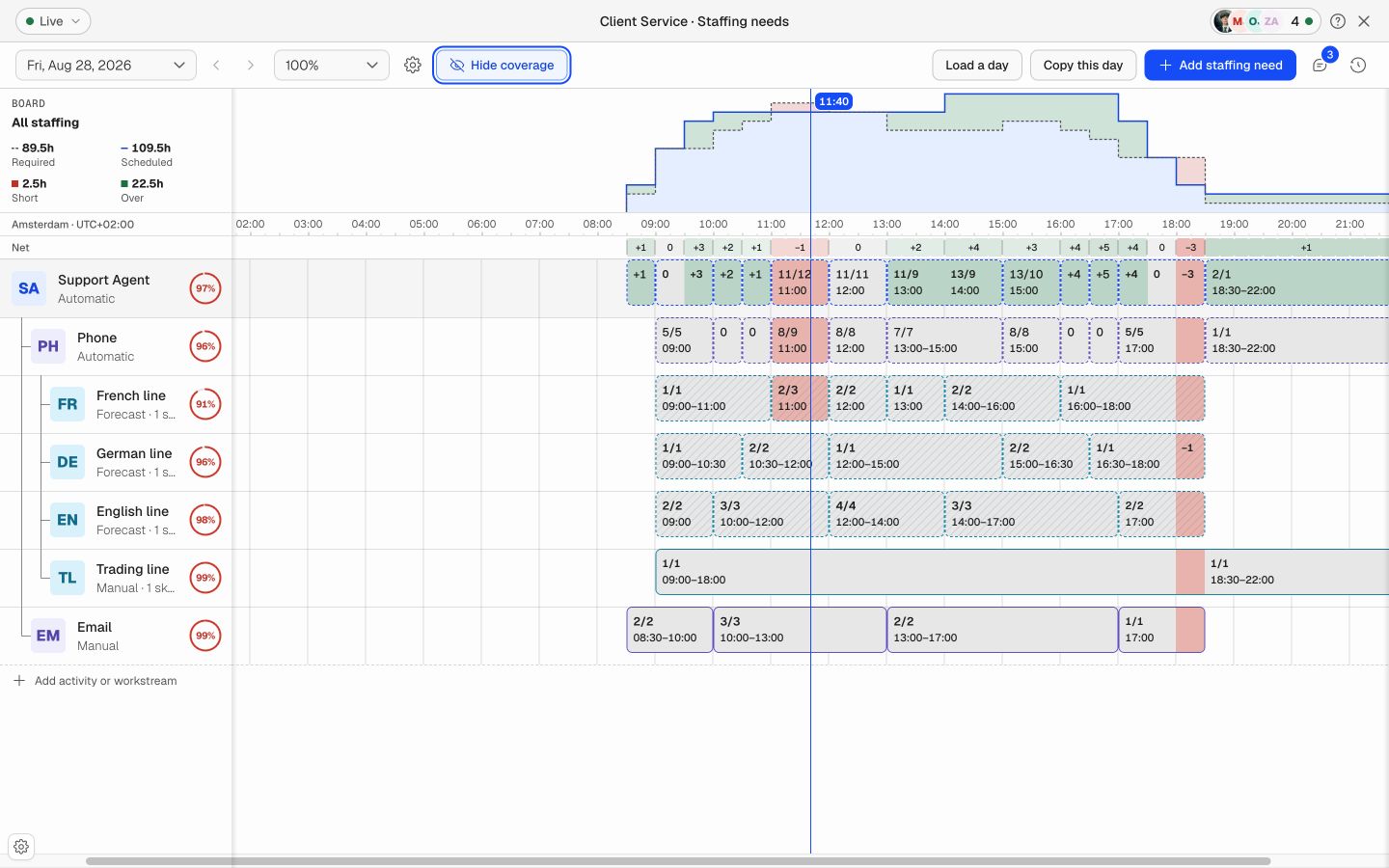
Soon coverage view comparing required and scheduled staffing with short and over intervals
You might have asked

“The schedule is full, but coverage still fails.”

“We need clearer minimum staffing by role and hour.”

“Breaks and handoffs keep creating hidden gaps.”

What to fix

What to include in the plan

A coverage plan is the operating layer underneath the schedule. The schedule says who is working; the plan says what the business needs covered and how you backfill when reality moves the schedule around.

Operating hours and service windows

Minimum people per time block

Required roles, skills, or certifications

Break and meal coverage

Handoff overlap requirements

Absence and callout backup rules

Escalation path when coverage drops below minimum
Read this next

1. Write the coverage requirement before assigning people

State the need without employee names. For each time range, record the required role or activity, the number of people or FTE, and the skills that make someone eligible. This gives managers one stable target even when the assigned people change.

Use separate requirement lines when the work has different eligibility or demand. A general support requirement and a French queue can share a team, but the qualified language coverage must remain visible inside the complete plan.

What this usually means

2. Compare required and scheduled staffing by interval

Required staffing is the target. Scheduled staffing is the qualified capacity assigned to that requirement. Net staffing is scheduled minus required. A negative value is short, zero is covered, and a positive value is over.

Make the comparison at the same time interval used to state the requirement. A daily total can look balanced even when the schedule is short through the busiest hour. Keep Short and Over FTE-hours separate so unlike periods do not cancel into one reassuring total.

Net staffing = scheduled โˆ’ required

Negative net: short coverage

Zero net: exactly covered

Positive net: surplus coverage

What to fix

3. Check qualified coverage, not only headcount

A full shift can still be undercovered when the available people do not have the required role, language, licence, or certification. Count a scheduled person only where their assigned work and current skills satisfy the requirement.

Verify the role assigned on the shift

Check required skills and minimum levels

Exclude expired qualifications

Protect dedicated posts from shared capacity

Keep one person from being counted several times at once

What to fix

4. Decide what happens when coverage is short

A coverage plan is incomplete until it states the response. Set the order of actions before the pressure starts. The right response can be a schedule adjustment, a moved break, voluntary cover, an on-call person, cross-trained support, reduced non-critical work, or a manager escalation.

Name the person who owns the coverage decision

Set the threshold that needs action

List approved backup roles or groups

Protect breaks, rest, and safety rules

Record why a material gap was accepted

Read this next

5. Review the plan before and during the day

Check the coverage plan before the schedule is published, after leave or absence changes it, and when actual demand moves away from the forecast. Review the complete operation first, then focus on the role, activity, or workstream that shows the gap.

After the day ends, separate a requirement problem from a scheduling problem. Change the requirement when the operating need was wrong. Change the schedule process when the requirement was right but qualified people were not in the correct place.

Where it breaks

Common mistakes

The biggest mistake is planning headcount without skills. Five people on shift can still leave you undercovered if only one of them can do the task that actually matters.

The second is treating breaks as free. If a minimum has to hold all shift, the breaks need covering too, otherwise your "safe" coverage drops every time someone steps away.

FAQ

A few questions that usually come next

What is a shift coverage plan?

The set of rules, people, roles, skills, and backup steps, that keep every time block safely staffed, even when the schedule changes underneath it.

How is coverage planning different from scheduling?

Coverage planning defines what the operation needs. Scheduling assigns real people to meet it. Get the plan wrong and even a full schedule leaves gaps.

How do you calculate a staffing coverage gap?

Subtract required staffing from scheduled qualified staffing for the same interval. A negative result is a shortage, zero is exactly covered, and a positive result is surplus coverage.

Why should Short and Over hours stay separate?

Extra coverage at one time cannot repair a shortage at another time. Separate totals stop unlike periods from cancelling into a misleading daily zero.

How often should a shift coverage plan be reviewed?

Review it before each schedule is published, after material leave or absence changes, during the day when demand moves, and after actual results become available.

Your next schedule could take 2 minutes.

Import your team, set your rules, hit auto-fill. Most teams are live the same day.

Try Soon free

30 days free ยท No credit card required

Already have an account?Sign in