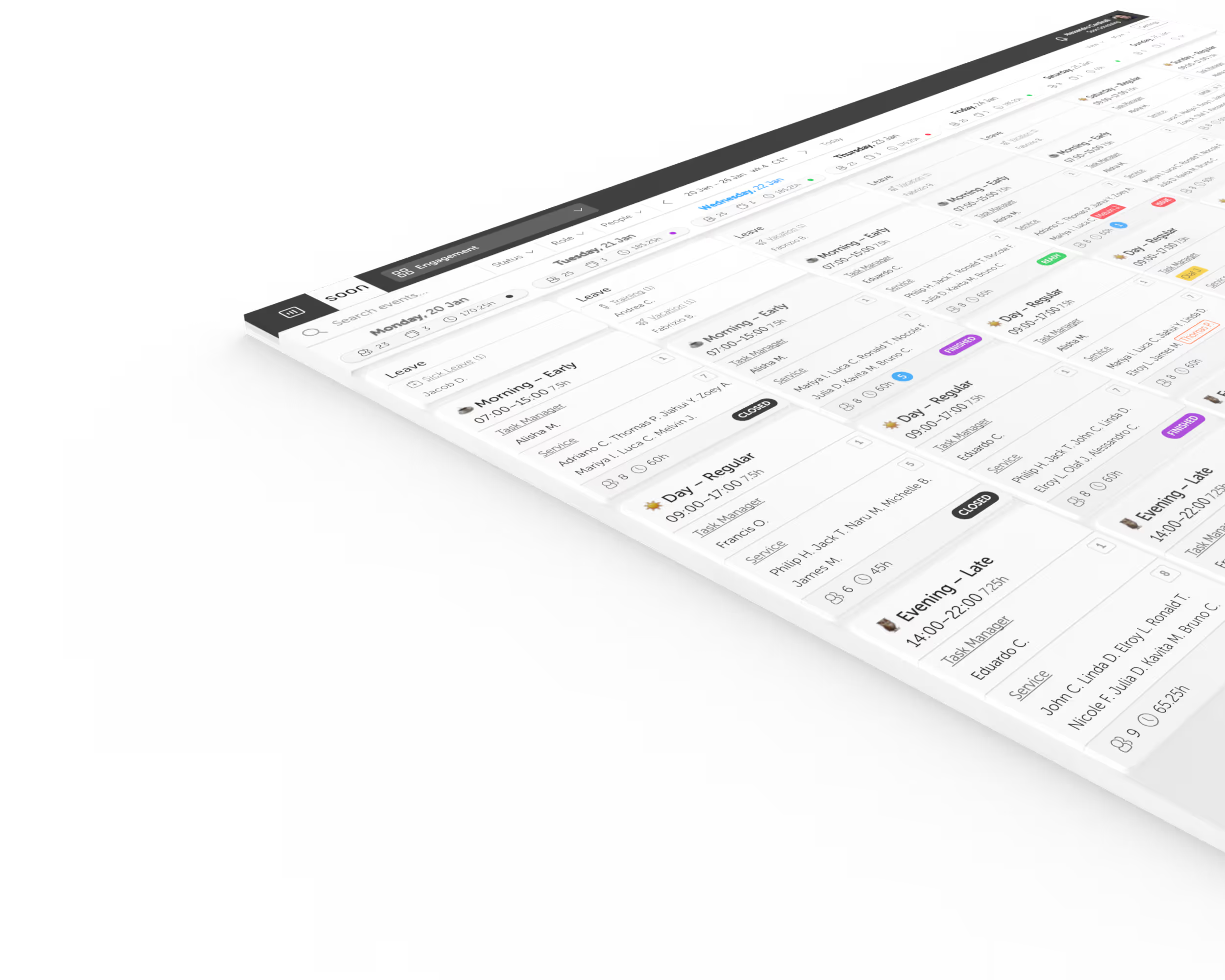
Time is a company'sbiggest investment.Most teams plan it with a spreadsheet.
You set the rules. Soon does the math.
Soon is workforce management software for shift-based operations teams of 10 to a few hundred people. It assigns people to shifts and plans what each person does during the shift, hour by hour.
What Soon does
You describe what the operation needs: opening hours, how many people each shift and activity requires, and the rules that apply, such as skills, availability, rest time between shifts and fairness.
Soon's solver assigns people to the shifts and schedules the activities inside them: phones, front desk, breaks, training, back-office work. Assigning a week of shifts typically takes seconds.
You review the result, adjust it by hand or by asking the AI agent, and publish. Your team sees its schedule in Soon and in its Google or Outlook calendar.
Scheduling is mathematically impossible for humans.
One team of 20. One week of shifts.
possible schedules. Exactly 2,432,902,008,176,640,000. That's 20 factorial. Roughly 2.4 quintillion arrangements of a single team, a single week.
And that's just who works when. Now add activities.
ways to arrange one 8-hour shift, hour by hour, with five possible activities per hour. That's 58. For one person. For one shift.
Now multiply them together.
Shifts × activities across twenty people and a full week lands past 10500 arrangements. More than every atom in the observable universe, raised to the seventh power.
No human can hold that search space in their head, let alone with contracts, skills, preferences, fairness, and labor law layered on top.
So planners pick one arrangement, call it the schedule, and hope. That's guesswork dressed up as planning.
Soon does the math humans can't.
Scheduling saves time. Better scheduling creates it.
Planning a week takes hours. Working a week takes thousands. That's where the real time lives.
Twenty people. Eight hours. 220 working days.
paid working hours a year. The investment a company has already made.
One more effective hour per person per day.
hours recovered. Roughly 2.2 full-time people appearing from nowhere. Compounding every year, without a single new hire.
Compliance. Preferences. Communication. Speed. Every fundamental a scheduling platform is judged on, Soon takes seriously. None of it is small. The number above is what arrives once that's settled. The dividend of every decision being a little better, compounding across a team.
Three convictions shape everything we build.
The schedule is always better.
Constraint solvers find the mathematically optimal answer given your rules, your coverage, your team's preferences. Not an approximation. The best possible schedule, computed in seconds.
AI does the work.
Describe what you need. The assistant builds it. The solver does the math. Workflows handle the repetition. The planner stops typing and starts steering.
Quality you can feel.
Open Soon next to any other scheduling tool. It should feel like a different generation. Every feature crafted. Every flow considered. Complexity under the hood, clarity on the surface.
Powerful enough. Simple enough.
Two bad options. An enterprise WFM built for 500-seat contact centers, or a spreadsheet held together by hope. Soon is the middle, on purpose. See it in Soon vs Microsoft Teams Shifts and the full comparison index.
Legacy WFM
Built for 500-person contact centers.
Traditionally priced per agent. Six-month deployments. Training required before anyone can publish a schedule.
Spreadsheets & MS Shifts
Free. And everywhere.
Break the moment someone calls in sick. No solver, no compliance, no single source of truth.
Soon
Both. On purpose.
A real solver for compliance and fairness. An interface a team lead masters in an afternoon. Honest pricing, no procurement theater.
How Soon is different
Each one links to the evidence. For a task-by-task comparison with a specific tool, see Soon vs Microsoft Teams Shifts, Soon vs Deputy and Soon vs When I Work.
01
It plans the whole day, not only the shift.
Who works when is half the job. Soon also schedules what each person does inside the shift, hour by hour, against the coverage each activity needs. See intraday management.
02
A solver computes the schedule.
Constraint programming searches for the assignment that best fits your coverage, rules and preferences, instead of a planner trying arrangements by hand. See auto-scheduling.
03
Prices are published.
Plans start at €49 a month for ten users, with a free trial and no credit card. Every plan and limit is on the pricing page.
04
It connects to the tools your team already uses.
Google and Outlook calendars, Microsoft Teams, Slack and Intercom, with single sign-on through Google or Microsoft. See integrations.
05
New releases ship every week.
The people who designed Soon still build it. Something reaches production every week, and the bigger releases are written up in the public changelog.
Who uses Soon
Operations teams where a desk, a queue or a ward has to be covered every hour, and people do more than one kind of work in a day.
The desk that can't go unmanned. The clinic that opens at 8 whether Sarah called in sick or not. The queue that can't drop. Operations teams of ten to a few hundred, on the front line of a real business.
Contact centers and support teams
Cover the queues and plan breaks, training and back-office work around demand.
Hiab UK brought abandoned calls down to 4%.
Banks and financial services
Run service desks and customer service departments on fair shift rotations.
Healthcare and pharmacy operations
See how many hours go to each activity across teams that share the work.
Housing associations
Keep the front desk and phones covered while staff handle repairs and tenant services.
Government offices
Let staff schedule themselves inside the rules the office sets.
The Netherlands Chamber of Commerce (KvK).
Emergency services
Staff round-the-clock rotations with rest rules and qualified cover on every shift.
The team behind Soon
Soon is built by its four founders, fully remote, from the Netherlands, since 2019.
Olaf Jacobson
Founder
Alessandro Cardinali
Founder
Melvin Jacobson
Founder
Thomas Picauly
Founder
Soon started as something else. We were freelancers ourselves and ran an Airbnb on the side, so we set out to build a product for freelancers in that direction. It failed completely.
Talking to customers along the way led us to scheduling software, and that became Soon. Build, fail, talk to customers, build again: it is still how we work.
Published pricing. Public roadmap. No enterprise sales theater.
Time is a company's biggest investment. We help you use it well.
Our shift work research library collects peer-reviewed findings on shift work health and safer schedule design, graded by strength and translated into scheduling practice.
Soon Technologies B.V. Registered in the Netherlands.
GDPR-compliant. Data stored in the EU.
Your next schedule could take 2 minutes.
Import your team, set your rules, hit auto-fill. Most teams are live the same day.
30 days free · No credit card required
Already have an account?Sign in