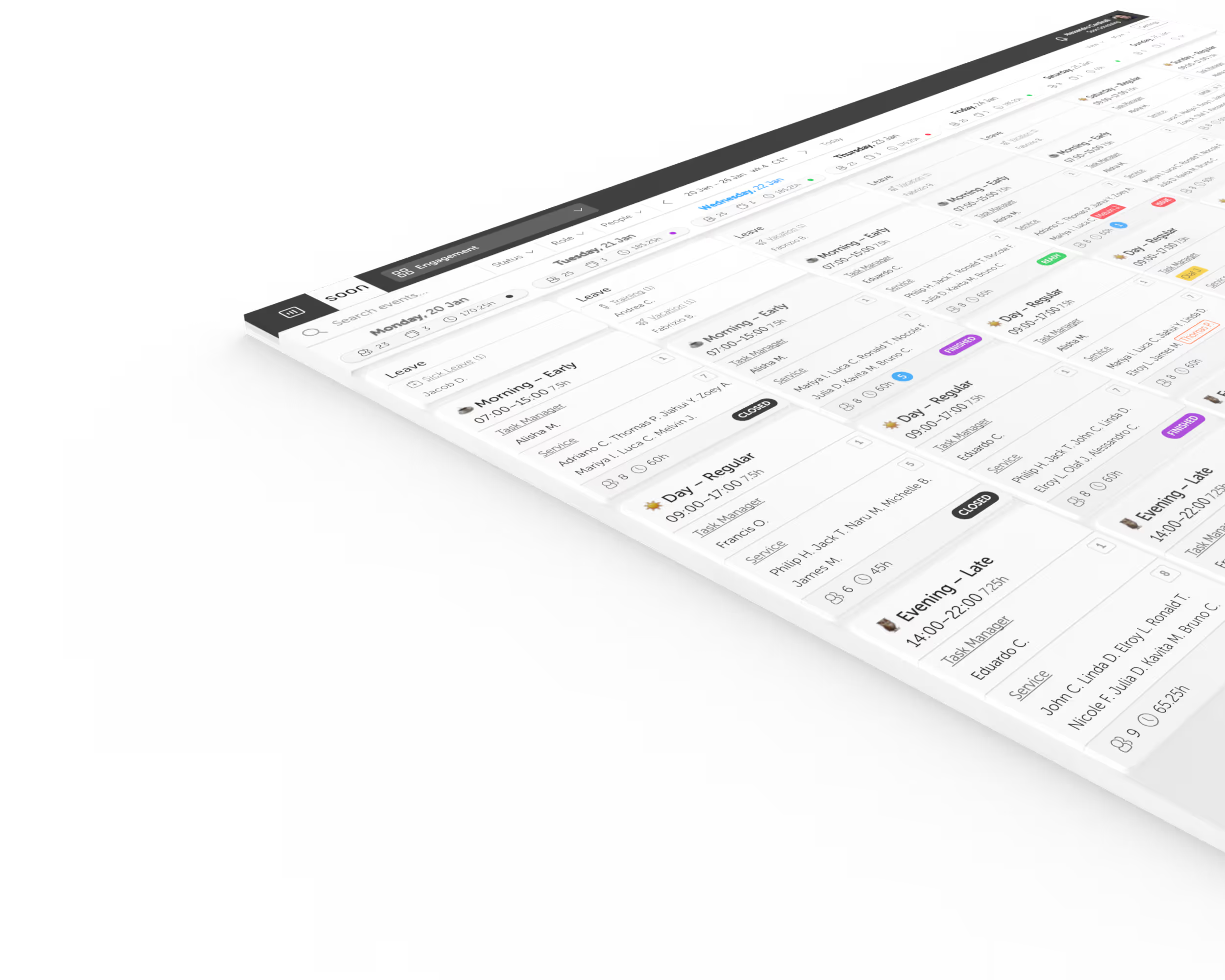
"scheduling"
Shift scheduling tools
They put a name against 8am to 4pm on Thursday and stop there.
Nothing about what those eight hours actually contain.
Intrashift scheduling is the planning of work inside a shift: which position each person occupies, when they rotate to the next one, and who relieves whom.
Written as one word or hyphenated, intrashift scheduling and intra-shift scheduling mean the same thing.
The search that keeps failing
Operations leaders who need this rarely arrive with the right word, because the market has never given them one. The journey is almost always the same three steps.
"scheduling"
They put a name against 8am to 4pm on Thursday and stop there.
Nothing about what those eight hours actually contain.
"intra-shift scheduling"
A list of six things to finish before you go off shift.
No order, no timing, no position, and nobody covering the post while you do them.
"intraday management"
A real discipline, built around forecast intervals and queue volume.
Demand-driven and interval-based, so it never says who is standing where.
Shift scheduling gives you 8-hour blocks. Task managers give you unordered checklists. Intrashift scheduling plans what happens inside the shift: who is at which position, when they rotate, and who bumps whom.
They differ on one thing above all: the unit being planned. Once you know whether you are planning a shift, an interval, a position, or a task, the right category is obvious.
| Discipline | Unit of planning | Time horizon | What it decides | Who it is for | What it stays silent on |
|---|---|---|---|---|---|
| Shift scheduling | A shift | Weeks ahead | Who works 8am to 4pm on Thursday, and whether the roster is legal and affordable | Schedulers, HR, operations managers | What the person does during those eight hours |
| Intraday management | A forecast interval | Today, interval by interval | How many people sit on which activity as actual volume drifts from forecast | Contact centre WFM and real-time analysts | Which physical position someone holds, and how long it takes to walk there |
| Intrashift scheduling | A position, held for an interval | Inside one shift, re-solved as reality changes | Which position each person holds, when they rotate, and who relieves them | Venues, parks, plants, kitchens, large-format retail | Who is rostered in the first place. It assumes the shift already exists. |
| Task management | A task | Before end of shift | What has to be finished, and by whom | Any team working from a checklist | Order, timing, location, and who holds the post while the task is done |
The four are layers rather than rivals. A forecast sizes the day, auto-scheduling fills the roster around your rules, and intrashift scheduling takes over the moment those people walk through the gate. Contact centres solve the demand-side version of the same day with intraday management, which moves people between activities as volume drifts rather than between physical posts.
The rules engine
A rotation is not a preference list. It is the output of rules that must hold and rules you would like to hold, solved together. Separating the two is what makes the result defensible in a grievance meeting and still pleasant to work.
Break timing and rest rules vary by jurisdiction and by contract, and the scheduling laws reference sets out which of them are statutory where you operate before you encode them as hard.
Rotation intervals
Most operations run 45 to 60 minute rotations and treat that as the house standard. Then the temperature climbs, and the same person who was comfortable on a 60 minute block indoors needs a 20 minute block on an outdoor post an hour later. If the interval lives in a template, somebody has to remember to change it. If it lives in the rules, it changes itself.
| Condition | Common interval | What drives it |
|---|---|---|
| Indoor position, low physical strain | 45 to 60 minutes | Attention and boredom, not safety. This is the comfortable default most operations run. |
| Standing, guest-facing, high interaction | 45 minutes | Service quality falls before the person notices it has fallen. |
| Outdoor position in heat or cold | 15 to 30 minutes | Exposure thresholds. The interval is set by the condition, not by the roster. |
| Full costume or character work | 15 to 30 minutes | Core temperature rises inside the costume far faster than ambient conditions suggest. |
These are the bands operators commonly work to, not a published standard. Your own exposure policy, contract, and local law decide the real numbers.
Going from 60 minutes to 20 minutes triples the number of handoffs needed to cover the same hour on the same post. Every one of those handoffs needs a body walking toward it. A heat policy that nobody costed is a heat policy that gets quietly ignored at 2pm on the busiest day of the year, which is precisely when it matters most.
Skills and certification
Every position carries requirements, and the useful distinction is between the ones that stop the operation and the ones that merely make it worse. A dispatch console needs a certified operator or the attraction does not run. A merchandise till would rather have someone experienced, and will survive an hour with someone who is not.
That difference is what lets a plan degrade gracefully when three people call in. The engine downgrades the positions that can be downgraded and protects the ones that cannot, instead of refusing to produce a plan at all.
A ride operator certificate with a renewal date is a scheduling constraint with a clock on it. The plan should know that someone drops out of the eligible pool for a position on a given date, and it should surface that far enough ahead for refresher training to be scheduled rather than discovered on the morning of.
Someone homed to one area may legitimately work three locations in a day. Skills decide where they can go, not the org chart, and a plan that respects only the org chart leaves capacity stranded on a quiet side of the site.
A trainee is not an independent unit of coverage. Rotating them away from their signer breaks the sign-off, so the pairing has to travel through the rotation together.
Walk time
On a large site, getting from a base to the next assignment can take 10 to 15 minutes.Walk time between positions is a genuine scheduling variable, and a plan that ignores it produces rotations that look perfect on paper and run four minutes late from the first handoff onward.
Unbudgeted walk time does not stay with the person walking. It arrives late at the next position, and the delay travels to the end of the chain, where somebody's break is waiting.
A 15 minute heat rotation across a site with 10 minute walks spends most of its labour in transit. Proximity stops being a nicety and becomes the thing that makes the policy affordable.
Crossing a busy midway at peak takes longer than crossing it at open. Treating walk time as one flat number understates the afternoon and overstates the morning.
Staggered relief chains
The mechanic has a name on the ground: a bump. The relief arrives at a position, says they are there to relieve you and where you are going, and you walk to that position, displacing whoever is there. Because each move costs walk time, the chain cascades in a stagger rather than a synchronised swap.Position rotation is the generic name for the same pattern in kitchens, production lines, and large-format retail.
Five minutes of walk time to the far side of the area, built into the plan rather than absorbed by whoever is waiting.
Certification is checked before the assignment is offered, not after the person arrives.
They are told where they are going during the handoff itself. That sentence is the whole communication protocol.
Four minutes later, because the platform and the queue are not the same place.
Third link in the chain, still inside the same rotation.
The break the whole chain existed to deliver, taken inside its statutory window.
In union contexts, bumping usually means something else entirely: the contractual right of a senior employee to displace a less senior one during a layoff or a job elimination. That sense is about employment, is governed by the collective agreement, and has nothing to do with the shift you are working today. The operational sense used here is a relief handoff between positions, lasts about fifteen seconds, and changes nobody's job. Both meanings are in active use, sometimes in the same building, which is exactly why it is worth naming the difference.
Dynamic re-solve
An intrashift plan is not a document. It is a position that has to be recomputed every time reality moves, and a large operation can re-solve hundreds of times a day.
A missing person is not one hole. It is every position that person would have held for the rest of the shift, and every chain that ran through them.
A four minute overrun at the top of a chain pushes the last break of that chain past its legal window. The plan has to absorb it or flag it.
The labour does not go home. It has to land somewhere useful, often in a different cost centre, with different certification requirements.
A queue builds in one area while another empties. Positions open and close, and the rotation has to be rebuilt around the new shape of the day.
Re-solving well means changing as little as possible. A plan that reshuffles the whole area because one person went home is technically optimal and operationally useless, because every changed line has to be walked to somebody and said out loud. Stability is a constraint in its own right. Demand-side movement is easier to anticipate than absence, which is where forecasting earns its place: it sizes the day well enough that the live re-solves are exceptions rather than the whole job.
Deviceless communication
At large venues, most of the people your plan governs are carrying no device at all during the shift, and at some operators being seen with a phone on the floor is a disciplinary matter. Push notifications, in-app schedules, and read receipts are not available to you. The plan has to reach people through the channels that actually exist on the floor.
A screen or printed sheet showing the current rotation for the area, refreshed whenever the plan is re-solved. This is where people look at the start of a shift and after every break.
A slip per person at shift start listing their positions and times. It survives a re-solve badly, which is exactly why the board and the radio exist alongside it.
Area leads carry the device. They receive changes and push them into the chain by hand, which makes lead workload a real constraint on how often you can re-solve.
The most reliable channel on site. The relief arrives and says where you are going. No app, no notification, no read receipt needed.
This constrains the plan itself, not just its distribution. A rotation that can be printed on one sheet, posted on a break-room wall, and spoken in a single sentence at each handoff is a rotation that will be followed. One that needs a screen in every pocket will not be.
Where intrashift scheduling sits
Forecasting sizes the day, shift scheduling decides who is rostered, and intrashift scheduling takes that roster as its input and plans the positions inside it. Nothing above it has to be replaced. The operators who feel this gap hardest run theme parks and attractions, where a single area can hold a dozen positions with different certifications, different heat exposure, and a walk between them, but the same mechanic runs in zoos, museums, stadiums, kitchens, and any site where a post cannot be left unattended.
The definitions and practical details operations teams ask for when they are naming this problem for the first time.
Intrashift scheduling is the planning of work inside a shift: which position each person occupies, when they rotate to the next one, and who relieves whom. Shift scheduling decides that someone works 8am to 4pm. Intrashift scheduling decides what those eight hours contain, position by position, usually in blocks of 15 to 60 minutes. It is written both as one word and as intra-shift scheduling, and the two mean the same thing.
Intraday management is a contact centre discipline. It compares actual volume against forecast during the day and moves people between activities to protect service level, working in forecast intervals. Intrashift scheduling works in positions and relief chains instead. It answers who is at the dispatch console right now, who takes over at 13:15, and how long it takes that person to walk there. Both operate inside the day, but one is demand-driven and one is position-driven, and a physical venue usually needs the position view.
A bump is the operational handoff that moves someone from one position to the next. A relief worker walks up, says they are there to relieve you and tells you where you are going, and you walk to that position, which displaces the person already there, and so on down the chain. Because every move costs walk time, the chain is staggered rather than synchronised. In union contexts the word bumping usually means something different: the seniority right to displace a less senior worker during a layoff. Both senses are real, and this page uses the operational one.
Most operations settle between 45 and 60 minutes for standard indoor positions, which is short enough to keep attention up and long enough that the site is not permanently in motion. Guest-facing positions that involve standing and constant interaction tend toward the shorter end. Anything involving heat, cold, or full costume tightens to 15 to 30 minutes. The interval should be an output of your rules rather than a number typed into a template, because the same person can need a 60 minute block indoors and a 20 minute block an hour later on an outdoor position.
Heat compresses everything. An outdoor position that runs on a 60 minute rotation in spring can need 15 to 30 minutes on a hot afternoon, and costume work reaches that threshold much earlier because core temperature rises inside the costume long before ambient conditions look dangerous. Tightening from 60 minutes to 20 minutes triples the number of handoffs needed to cover the same hour, so heat is a staffing question as much as a safety one. It also moves breaks, because a shortened exposure block usually has to end somewhere shaded or indoors.
At large venues most frontline staff have no phone on them during a shift, and at some operators being seen with one on the floor is a disciplinary matter. That rules out notification-based scheduling entirely. What works is a break-room display board showing the current rotation, printed slips handed out at shift start, radio to area leads who push changes into the chain by hand, and the bump itself, where the relief says out loud where you are going next. A plan that cannot be published to a wall and spoken in one sentence will not survive contact with the floor.
No. It sits underneath one. Forecasting still sizes the day, and shift scheduling still decides who is rostered and whether the roster is compliant and affordable. Intrashift scheduling adds the layer those systems have never covered, which is the position plan inside each rostered shift. If your workforce management stack already produces a clean daily roster, that roster is the input.
No, and this is the confusion that sends most searches to the wrong software. A task manager holds a list of things to finish before end of shift, with order and timing left to the person. Intrashift scheduling plans a sequence of positions with fixed handoff times, relief chains, and coverage that cannot lapse while somebody steps away. A position cannot be ticked off. It has to be held until someone else takes it.
Import your team, set your rules, hit auto-fill. Most teams are live the same day.
30 days free · No credit card required
Already have an account?Sign in