How many agents do you need for 100 calls a day?
Three people on the phones at peak, five on the schedule, and a rota that survives lunch.
The short answer
100 calls a day over an 8-hour line, with the busiest hour carrying about 15 percent of volume, peaks at 15 calls an hour: that hour takes 3 agents on the phones, and 5 scheduled at 30 percent shrinkage.
- Peak-hour calls
- 15
- Offered load
- 1 erlangs
- Agents on phones
- 3
- Scheduled agents
- 5
- Service level hit
- 92.3%
- Occupancy
- 33.3%
Why the math lands there
Spread 100 calls across an 8-hour phone window and the busiest hour carries about 15 percent of the day, roughly 15 calls. At a 240 second average handle time, that is one full hour of handle time landing inside one hour of clock time. Erlang C says 2 agents answer 69 percent of those calls within 20 seconds, while 3 agents answer 92 percent. To hit an 80/20 service level, the answer is 3 agents on the phones at peak.
Be honest about what that means. Those 3 agents will be on calls 33.3 percent of their logged-in time in the busiest hour, and less than that for the rest of the day. The average hour brings 12.5 calls and also needs 3 people to hit the target. This is not a call center. It is a phone rota for 2 or 3 cross-trained people who do other work between calls.
On the schedule, 3 on the phones becomes 5 scheduled agents once you apply 30 percent shrinkage for breaks, meetings, training, and absence. And that fifth body is not padding. Two people can hold the line at a 69 percent service level if the business accepts an 80 second average speed of answer in the busy hour. The third person at peak is what makes lunch breaks, team meetings, and sick days survivable instead of an outage.
- 1100 calls a day with roughly 15 percent landing in the busiest hour means planning for 15 calls in the peak hour; the average hour brings 12.5.
- 215 calls an hour times 240 seconds of handle time is 1 erlangs of offered load: 1 hours of phone work arriving every hour.
- 3Counting up from 1 agents, 3 is the first count where Erlang C clears the 80/20 target: 92.3 percent of calls answered within 20 seconds, with an average wait of 10.9 seconds.
- 4At 3 agents, occupancy is 33.3 percent: the share of each logged-in hour spent handling calls rather than waiting for the next one.
- 5Breaks, meetings, training, and absence take agents off the phones for 30 percent of paid time, so keeping 3 on the phones means scheduling 5.
One agent either way
Erlang math is a cliff, not a slope. This is the same peak hour with one or two agents more or fewer on the phones.
| Agents on phones | Answered in 20s | Average wait | Occupancy |
|---|---|---|---|
| 1 | 0% | queue never clears | 100% |
| 2 | 69.3% | 80s | 50% |
| 3the answer | 92.3% | 10.9s | 33.3% |
| 4 | 98.4% | 1.6s | 25% |
| 5 | 99.7% | 0.2s | 20% |
Peak hour vs average hour
A daily total hides the curve. These are the two hours your day swings between under this page's assumptions; your real intraday pattern replaces them the moment you have interval data.
| Hour | Calls | Agents on phones | Occupancy |
|---|---|---|---|
| Peak hour | 15 | 3 | 33.3% |
| Average hour | 12.5 | 3 | 27.8% |
If your handle time or target differs
Agents on the phones for 15 calls an hour, across handle times and the two most common service level targets. Adjust every input live in our Erlang C calculator.
| Average handle time | 80/20 target | 90/30 target |
|---|---|---|
| 3 minutes | 2 agents | 3 agents |
| 4 minutesthis page | 3 agents | 3 agents |
| 5 minutes | 3 agents | 4 agents |
| 6 minutes | 4 agents | 4 agents |
Scheduled headcount sits above every number here: this page assumes 30 percent shrinkage, and your own rate comes out of our shrinkage tool.
What Erlang C does not tell you
Erlang C treats 15 calls an hour as a smooth stream of arrivals. At this volume the hour is lumpy: three calls can land in the same five minutes and then nothing for twenty. Three agents absorb that clustering, two agents turn it into the bad afternoon that generates a complaint. And the peak rarely stays where the plan put it: at 100 calls a day a single shipping problem or outage email can double an hour's volume without warning.
The formula assumes dedicated agents. Here your agents are cross-trained staff answering between other tasks, so their real availability is softer than a roster line, and someone deep in a returns spreadsheet does not pick up within 20 seconds. Erlang C also has no concept of a backup rule. The decision that matters at this size is who answers first, who is second ring, and what happens when one of your 2 or 3 is out. That is a coverage question as much as a queueing one, and it deserves as much design time as the math.
Shrinkage of 30 percent behaves like an average across a large team, but across 2 or 3 people it arrives in indivisible units. A sick day does not remove 30 percent of an agent, it removes a whole person, which at this size is a third to half of your peak-hour line. No average protects you from that. A named backup with the phone skills and the permission to drop other work does.
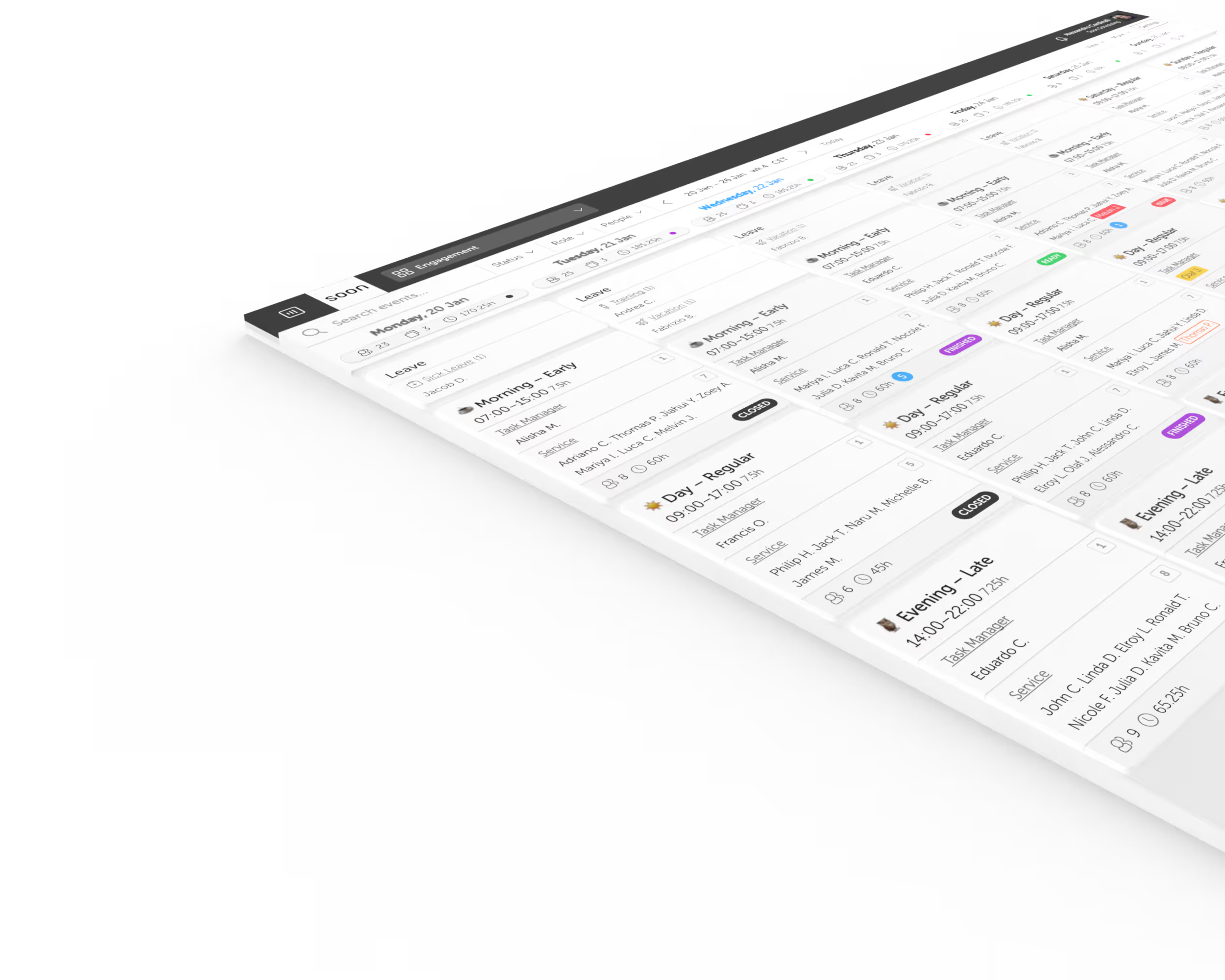
The agent count is the input; the schedule is the work. Turning 5 scheduled agents into shifts that follow your call curve, respect breaks, and survive swaps is what Soon builds automatically, with intraday coverage tracking when the forecast misses.
Frequently asked questions
- How many agents do you need for 100 calls a day?
- For 100 calls a day over an 8-hour window, with the busiest hour at about 15 calls, a 240 second average handle time, and an 80/20 target, you need 3 agents on the phones in the peak hour, which delivers a 92 percent service level. After applying 30 percent shrinkage, that becomes 5 scheduled agents.
- Can 2 people handle 100 calls a day?
- Two agents in the 15-call peak hour deliver a 69 percent service level with an average speed of answer around 80 seconds. If the business accepts that wait, a two-person line technically holds. What it cannot survive is lunch, a meeting, or a sick day, because dropping to one person leaves a queue that never stabilizes at peak.
- Is 100 calls a day enough to need a call center?
- No. Three agents handling 15 peak calls run at 33.3 percent occupancy, meaning they are on calls about a third of their logged-in time in the busiest hour and less for the rest of the day. The practical setup is a small cross-trained group with a clear rota and a named backup rule, where a ringing phone preempts whatever else is on the desk.
- What happens if only 1 person answers 100 calls a day?
- The peak hour breaks. Fifteen calls at a 240 second handle time is a full hour of work arriving inside one hour, so a single agent's queue never stabilizes and the effective service level at peak is 0 percent. Off-peak hours may feel manageable, which is why single-person phone coverage fails quietly until the busy hour exposes it.
- Why does a 100-call day need 5 people on the schedule?
- Because absence arrives in whole people. Keeping 3 available through the 15-call peak means scheduling 5 once breaks, meetings, training, and sick days take their usual 30 percent of paid time. On a line this size the extra people are rarely idle, they are the reason lunch can exist without the queue dropping to the 2-agent tier and its 69 percent service level.
Adjacent staffing questions
How many agents do you need for 500 calls a day?
The answer is 8 on the phones at peak and 12 on the schedule, but only if your day is as flat as this page assumes.
8 on phones · 12 scheduled · 80/20
See the math →How many agents do you need for 25 calls an hour?
4 agents on the phones, 6 on the schedule, and an occupancy number you will need to defend.
4 on phones · 6 scheduled · 80/20
See the math →How many agents do you need for 50 calls an hour?
Six on the phones, nine on the schedule, and an open question the math cannot answer: who owns the queue.
6 on phones · 9 scheduled · 80/20
See the math →How many people do you need to cover 16 hours a day, Monday to Friday, with 8-hour shifts?
Two 8-hour shifts a day, five days a week: 80 coverage hours, exactly 2.0 FTE, and no room for a single sick day.
Coverage math
See the math →Your next schedule could take 2 minutes.
Import your team, set your rules, hit auto-fill. Most teams are live the same day.
30 days free · No credit card required
Already have an account?Sign in