Skip to content

Scheduling laws in California

California attaches a price to almost every schedule shape it dislikes and forbids almost none of them. The exception is the meal period, and it behaves like a deadline rather than a break.

17 binding rulesSources last read 6 August 2026

United States: the layer this sits on

Federal law is a floor with a conspicuous hole in it: the Fair Labor Standards Act sets no meal or rest break entitlement at all, and no limit on hours in a day for adults. Almost everything that shapes a shift is state law, so a federal answer on its own is not an answer. Pick a state.

Enforcement: California Department of Industrial Relations (wage and hour rules enforced by the Division of Labor Standards Enforcement, known as the Labor Commissioner's Office; heat illness standards enforced by the Division of Occupational Safety and Health, Cal/OSHA)

What this jurisdiction regulates

California regulates scheduling through two stacked layers: the Labor Code, and the Industrial Welfare Commission wage orders, of which Order 7-2001 governs the mercantile (retail and wholesale) industry and Order 5-2001 governs public housekeeping (restaurants, bars, hotels, hospitals and residential care). Almost nothing in the state layer forbids a schedule outright. Instead it attaches a price to schedule shapes the state dislikes: overtime multipliers past eight and twelve hours a day, a flat one-hour premium for every workday a meal or rest period is missed, and reporting time pay when a shift is cut short. Hard prohibitions exist only for minors and, in one city, for back-to-back closing and opening shifts.

Everything here is a price, except the one rule that is a wall

The most protective wage-and-hour state in the country sets no maximum daily hours for an adult and no general minimum rest between shifts. A sixteen-hour shift is lawful. Starting the same person again eight hours later is lawful. Both are simply expensive: overtime past eight hours in a day, double time past twelve, a premium rate across the seventh consecutive day in a workweek, a minimum of two hours when a scheduled shift is cut short, another hour when the day is split around a long unpaid gap. California legislates the invoice.

A scheduler learns from that pattern that every rule is negotiable, and then meets the meal period, which is not. It catches people because it is measured from clock-in rather than from the middle of the shift. The first meal must begin before the end of the fifth hour of work and the second before the end of the tenth. The length of the shift is irrelevant to the deadline. Elapsed time since the employee started is the only clock that counts.

That is how a lunch placed at hour six of a ten-hour shift, which looks like the humane answer and is what most planners would draw by hand, becomes a violation worth an hour of pay for the whole workday. The premium runs per workday rather than per period missed, so a day that goes wrong on both the meal and the rest schedule costs one hour and not two. A month of them still adds up faster than any of the overtime multipliers on this page.

The rest period runs on different logic again. Ten paid minutes for every four hours worked or major fraction of four, placed as near the middle of each work period as practicable. It is authorised and permitted rather than provided, so nobody has to be made to take it, but the schedule still has to leave room, and a shift built wall to wall with committed coverage does not.

California is also one of the few places in this engine where heat is a number instead of a duty. Shade must exist from eighty degrees outdoors, high-heat procedures begin at ninety-five, and indoors a cool-down area is required from eighty-two. Those triggers read off a thermometer at the work area, which means they arrive in the middle of a published schedule rather than at planning time. That is a different engineering problem from every other rule here, and it is the one most rostering systems have no place to put.

Two of the rules below are municipal rather than statewide. The City of Los Angeles Fair Work Week ordinance is the only verified California source in this registry for advance notice and for a minimum gap between shifts, and it does not describe San Francisco, Emeryville, Berkeley or unincorporated Los Angeles County, each of which runs its own ordinance on different figures that this engine has not verified. Read the Los Angeles numbers as belonging to Los Angeles.

How California sits on the federal floor

California stacks on top of federal law rather than replacing it. Everything on the federal layer still applies here: the fixed workweek that may not be averaged, the paid status of short breaks, and the forty-hour overtime line. Where both reach the same hour, the employee gets whichever is more generous, which in practice means California governs the shape of the day and federal law governs the boundary of the week.

The two layers do not even agree on what an overtime hour is. Federal overtime is a weekly quantity and starts at forty. California overtime is also a daily quantity and starts at eight, so a four-day week of ten-hour shifts generates eight hours of overtime in California and none at all under federal law. A payroll model that computes only the federal figure will underpay a California roster it considers perfectly compliant.

Before the rules, the labels

Every rule below carries one of three labels, and they are not interchangeable. Blurring binding law into official guidance would push a reader either into over-complying with something advisory or into dismissing the whole page once they discovered the difference. A checked absence is the third answer, and on several of these pages it is the one people came for.

Rest and meal breaks

4 rules in California

Rest and meal breaks

First 30-minute off-duty meal period before the fifth hour ends

Binding law

An employer shall not employ an employee for a work period of more than five hours per day without providing the employee with a meal period of not less than 30 minutes. Unless the employee is relieved of all duty during the 30 minute meal period, it is an 'on duty' meal period and counted as time worked; an on-duty meal period is permitted only where the nature of the work prevents relief from all duty and a revocable written agreement is in place. The meal period may be waived by mutual consent of employer and employee only when a work period of not more than six hours will complete the day's work.

Who this covers

All non-exempt employees under an IWC wage order, including retail (Order 7-2001) and restaurants (Order 5-2001). Does not apply to employees exempt in an administrative, executive orโ€ฆRead the full scope

All non-exempt employees under an IWC wage order, including retail (Order 7-2001) and restaurants (Order 5-2001). Does not apply to employees exempt in an administrative, executive or professional capacity. Statutory carve-outs in Labor Code 512(c)-(g) displace the standard rules where a qualifying collective bargaining agreement is in place, for wholesale baking, motion picture and broadcasting, construction, commercial drivers, security officers, electrical corporations, gas corporations, local publicly owned electric utilities and (added by SB 693, Stats. 2025, Ch. 95, effective 1 January 2026) water corporations. Labor Code 512(b)(2) lets a commercial driver transporting feed to a remote rural customer start the meal after six hours if paid at least 1.5x the state minimum wage. Wage Order 5-2001 adds two further public-housekeeping carve-outs the mercantile order does not have: section 11(E) permits on-duty meal periods without penalty for staff in 24-hour residential care for children and for elderly, blind or developmentally disabled residents under stated conditions, and section 11(F) gives an employee other than one on the night shift the right to an off-duty meal period on 30 days' notice.

How to encode this in a schedule

Hard constraint: every assignment block longer than 5:00 of work must contain a 30-minute unbroken non-working interval that BEGINS at or before 5:00 of elapsed worked time from clock-in. Model it as a deadline from shift start, not as a midpoint of the shift. Blocks of 5:00 to 6:00 may omit it only where a signed mutual waiver is on file.

Break minutes
30
After hours
5
Must start before elapsed hours
5
Waiver allowed if total shift hours at most
6
Paid
no

The mistake employers make

Schedulers place the meal in the middle of the shift. The DLSE states that 'a meal period must be provided no later than the end of the employee's fifth hour of work' (https://www.dir.ca.gov/dlse/faq_mealperiods.htm). On a ten-hour shift a lunch at hour six is already late. The waiver also only reaches shifts of six hours or less, so it cannot rescue a seven-hour shift with no break scheduled.

Why this figure does not travel

breakMinutes 30 / afterHours 5 is a DEADLINE measured from clock-in (mustStartBeforeElapsedHours), not a trigger that a break becomes due. Japan's 45-after-6 and the UK's 20-after-6 are triggers with no placement deadline in the statute (the UK's mid-shift placement comes from GOV.UK guidance). Same key shape, different obligation.

Citation: California Labor Code section 512(a); IWC Wage Order 7-2001 section 11(A) and 11(C) (8 CCR section 11070(11)); IWC Wage Order 5-2001 section 11(A) (8 CCR section 11050(11)(A))

California Legislative Information (leginfo.legislature.ca.gov), official text of the Labor Codelast read 6 August 2026
Rest and meal breaks

Paid 10-minute rest period per four hours or major fraction thereof

Binding law

Every employer shall authorize and permit all employees to take rest periods, which insofar as practicable shall be in the middle of each work period. The authorized rest period time shall be based on the total hours worked daily at the rate of ten minutes net rest time per four hours or major fraction thereof. However, a rest period need not be authorized for employees whose total daily work time is less than three and one-half hours. Authorized rest period time shall be counted as hours worked, for which there shall be no deduction from wages.

Who this covers

All non-exempt employees under an IWC wage order. Retail falls under Order 7-2001 (mercantile industry: purchasing, selling or distributing goods at wholesale or retail, or renting goods)โ€ฆRead the full scope

All non-exempt employees under an IWC wage order. Retail falls under Order 7-2001 (mercantile industry: purchasing, selling or distributing goods at wholesale or retail, or renting goods). Restaurants fall under Order 5-2001 (public housekeeping industry, which expressly names restaurants, night clubs, taverns, bars, cocktail lounges, lunch counters and cafeterias). The rest period text in section 12(A) is materially identical in both orders, read verbatim. Wage Order 5-2001 section 12(C) carves out staff with direct responsibility for children in 24-hour residential care. Labor Code 226.7(f), added by AB 1512 (Stats. 2020, Ch. 343) and operative until 1 January 2027, permits security officers of registered private patrol operators covered by a qualifying collective bargaining agreement to remain on call during rest periods.

How to encode this in a schedule

Hard constraint on paid time inside the block: shifts of 3.5 to 6 hours need one 10-minute paid non-working interval, over 6 up to 10 hours need two, over 10 up to 14 hours need three, each placed as near the middle of its four-hour work segment as practicable. Because rest time is paid and counted as hours worked, it does not extend the shift and must be absorbed into coverage planning, not appended to it.

Break minutes
10
After hours
4
Trigger shift hours
3.5
Paid
yes
Breaks by shift length:
Under 3.5h: 0; 3.5h to 6h: 1; Over 6h to 10h: 2; Over 10h to 14h: 3
Break count derivation:
Computed from the wage order formula plus the DLSE reading of 'major fraction' as more than two hours of a four-hour segment. Not a table published by DIR.

The mistake employers make

The phrase 'major fraction thereof' is read by the DLSE as anything more than two hours of a four-hour segment: 'The Division of Labor Standards Enforcement (DLSE) considers anything more than two hours to be a major fraction of four' (https://www.dir.ca.gov/dlse/faq_restperiods.htm). A 6:01 shift therefore owes two rest breaks, not one, and a 10:01 shift owes three. Rounding shift lengths down before computing break counts silently underfunds coverage. Separately, because rest time is paid working time, an employee cannot be sent off the clock for it or required to stay reachable in a way that defeats relief from duty.

Why this figure does not travel

breakMinutes 10 / afterHours 4 RECURS (one per four hours or major fraction). The UK's 20-minute break does not recur: a 12-hour UK shift earns 20 minutes total, a 12-hour California shift earns three 10-minute rests plus two 30-minute meals. Recurrence, not duration, is the real difference between these two jurisdictions.

Citation: IWC Wage Order 7-2001 section 12(A) (8 CCR section 11070(12)(A)); IWC Wage Order 5-2001 section 12(A) (8 CCR section 11050(12)(A)); California Labor Code section 226.7(d)

California Department of Industrial Relations, Industrial Welfare Commission Order No. 7-2001 (Mercantile Industry)last read 6 August 2026

Rest and meal breaks

One hour of premium pay per workday a meal or rest period is missed

Binding law

If an employer fails to provide an employee a meal or rest or recovery period in accordance with a state law, the employer shall pay the employee one additional hour of pay at the employee's regular rate of compensation for each workday that the meal or rest or recovery period is not provided. A rest or recovery period mandated pursuant to state law shall be counted as hours worked, for which there shall be no deduction from wages.

Who this covers

Applies wherever a meal, rest or recovery period is mandated by state law, including a statute or an applicable regulation, standard or order of the Industrial Welfare Commission, theโ€ฆRead the full scope

Applies wherever a meal, rest or recovery period is mandated by state law, including a statute or an applicable regulation, standard or order of the Industrial Welfare Commission, the Occupational Safety and Health Standards Board, or the Division of Occupational Safety and Health. Labor Code 226.7(e) provides that the section does not apply to employees exempt from meal or rest or recovery period requirements pursuant to other state laws. Labor Code 226.7(f), operative until 1 January 2027, carves out security officers of registered private patrol operators under a qualifying collective bargaining agreement.

How to encode this in a schedule

Cost constraint, not a prohibition: attach a penalty of at least one hour of pay to any generated day where a required meal interval, rest interval or heat recovery interval is absent or late. Because the statutory floor is one hour per workday and the ceiling per workday is not settled from a primary government source, size the penalty as a large fixed per-day cost so that the optimiser never trades a break away to close a coverage gap, rather than trying to model an exact multi-category total.

Premium hours of pay
1
Per
workday
Rate:
regular rate of compensation

The mistake employers make

The premium is per workday, not per missed break. The DLSE is explicit: where an employer does not provide all of the rest periods required in a workday, 'the employee is entitled to one additional hour of pay for that workday, not one additional hour of pay for each rest period that was not provided during that workday' (https://www.dir.ca.gov/dlse/faq_restperiods.htm). The meal period FAQ uses the same per-workday framing. The premium is owed at the regular rate of compensation, which is broader than the base hourly rate. Whether a single workday can carry a meal premium AND a separate rest premium is a live question that no dir.ca.gov or leginfo page answers, so do not encode a two-hour-per-day figure as settled law.

Citation: California Labor Code section 226.7(c) and (d)

California Legislative Information (leginfo.legislature.ca.gov), official text of the Labor Code section 226.7last read 6 August 2026

Rest and meal breaks

Second 30-minute meal period before the tenth hour ends

Binding law

An employer shall not employ an employee for a work period of more than 10 hours per day without providing the employee with a second meal period of not less than 30 minutes, except that if the total hours worked is no more than 12 hours, the second meal period may be waived by mutual consent of the employer and the employee only if the first meal period was not waived.

Who this covers

Same coverage as the first meal period. Note that the second meal period for restaurants and other public housekeeping employers comes from Labor Code 512(a), not from the wage order: Wageโ€ฆRead the full scope

Same coverage as the first meal period. Note that the second meal period for restaurants and other public housekeeping employers comes from Labor Code 512(a), not from the wage order: Wage Order 5-2001 section 11 contains no second-meal-period paragraph, whereas Wage Order 7-2001 restates the rule at section 11(B). Wage Order 5-2001 section 11(D) lets health care industry employees working shifts in excess of eight total hours in a workday voluntarily waive one of their two meal periods under a written agreement signed by both parties and revocable by the employee on at least one day's written notice.

How to encode this in a schedule

Hard constraint: every assignment block longer than 10:00 of work must contain a second 30-minute unbroken non-working interval beginning at or before 10:00 of elapsed worked time. A block over 12:00 must contain two meal intervals with no waiver path available at all.

Break minutes
30
After hours
10
Must start before elapsed hours
10
Waiver allowed if total shift hours at most
12
Waiver requires first meal taken
yes

The mistake employers make

The two waivers cannot both be used. Employers running 11-hour and 12-hour shifts often collect a blanket waiver at hire and let staff skip both meals to leave early. The statute permits waiving the second meal only if the first was actually taken, so a double waiver is void and the day carries premium pay.

Citation: California Labor Code section 512(a); IWC Wage Order 7-2001 section 11(B) (8 CCR section 11070(11)(B)); IWC Wage Order 5-2001 section 11(D) (8 CCR section 11050(11)(D)) for the health care waiver

California Legislative Information (leginfo.legislature.ca.gov), official text of the Labor Codelast read 6 August 2026

Hours and overtime limits

5 rules in California

Hours and overtime limits

Alternative workweek schedule permits ten-hour days without daily overtime, and twelve-hour days in health care

Binding law

Upon the employer's proposal, employees may adopt a regularly scheduled alternative workweek authorising work of no longer than 10 hours per day within a 40-hour workweek without payment of daily overtime. The schedule is deemed adopted only if it receives approval in a secret ballot election by at least two-thirds of affected employees in a readily identifiable work unit. Work beyond the schedule established by the agreement up to 12 hours a day, or beyond 40 hours per week, is paid at one and one-half times the regular rate; work in excess of 12 hours per day, and any work in excess of eight hours on days worked beyond the regularly scheduled number of workdays established by the agreement, is paid at double the regular rate. Any alternative workweek agreement shall provide for not less than four hours of work in any shift and not less than two consecutive days off within a workweek.

Who this covers

Available only to a readily identifiable work unit that has adopted the schedule by secret ballot election. Not available by individual agreement, offer letter, or employer policy. Theโ€ฆRead the full scope

Available only to a readily identifiable work unit that has adopted the schedule by secret ballot election. Not available by individual agreement, offer letter, or employer policy. The 10-hour ceiling in Labor Code 511(a) is the general rule; Wage Order 5-2001 section 3(B)(8) separately permits employers of health care industry employees to institute, through the same election procedures, a regularly scheduled alternative workweek that includes workdays exceeding ten but not more than twelve hours within a 40-hour workweek without overtime compensation.

How to encode this in a schedule

Unlocks a schedule shape rather than restricting one: only work units flagged as having a validly adopted alternative workweek may be assigned four ten-hour days without daily overtime cost, and only health care work units under Wage Order 5-2001 may be assigned twelve-hour days that way. Store the adoption as a unit-level attribute with its adopted schedule and its governing wage order, apply the standard eight-hour overtime threshold to every unit lacking it, and enforce the agreement-level floors of four hours minimum per shift and two consecutive days off per workweek.

Max scheduled daily hours
10
Max scheduled daily hours health care wage order 5
12
Max scheduled weekly hours
40
Election method
secret ballot
Double time threshold hours
12
Min shift hours
4
Minimum consecutive days off per workweek
2
Election approval threshold:
two-thirds of affected employees

The mistake employers make

Employers introduce four-day, ten-hour weeks by asking staff to sign an agreement. That is not an alternative workweek. Without a two-thirds secret ballot in a readily identifiable work unit, every ninth and tenth hour is overtime retroactively. The second trap runs the other way: it is widely repeated that a 3x12 is impossible in California, and that is wrong for health care. Wage Order 5-2001 section 3(B)(8) expressly permits an adopted schedule with workdays exceeding ten but not more than twelve hours, so a hospital or residential care unit under Order 5 can lawfully run twelve-hour shifts that a retail unit under Order 7 cannot.

Citation: California Labor Code section 511(a)-(b); IWC Wage Order 7-2001 section 3(B)(1)-(2) (8 CCR section 11070(3)(B)); IWC Wage Order 5-2001 section 3(B)(1)-(2) and 3(B)(8) (8 CCR section 11050(3)(B))

California Legislative Information (leginfo.legislature.ca.gov), official text of the Labor Codelast read 6 August 2026

Hours and overtime limits

Daily overtime at eight hours and double time at twelve

Binding law

Eight hours of labor constitutes a day's work. Any work in excess of eight hours in one workday and any work in excess of 40 hours in any one workweek and the first eight hours worked on the seventh day of work in any one workweek shall be compensated at the rate of no less than one and one-half times the regular rate of pay. Any work in excess of 12 hours in one day shall be compensated at the rate of no less than twice the regular rate of pay.

Who this covers

Non-exempt employees 18 or over, and 16- and 17-year-olds not required by law to attend school and not otherwise prohibited by law from the work. Does not apply to employees exempt in anโ€ฆRead the full scope

Non-exempt employees 18 or over, and 16- and 17-year-olds not required by law to attend school and not otherwise prohibited by law from the work. Does not apply to employees exempt in an administrative, executive or professional capacity, nor to employees on a validly adopted alternative workweek schedule up to the scheduled hours. Wage Order 5-2001 section 3(A)(2) sets a different regime for employees with direct responsibility for children in 24-hour residential care: overtime after 40 hours in the workweek, double time past 48 hours in the week and past 16 hours in a workday.

How to encode this in a schedule

Cost constraint with no upper bound: California sets no maximum daily hours for adults, so a scheduler must model hours 8 to 12 at 1.5x and hours beyond 12 at 2x rather than blocking the assignment. Daily overtime is computed per workday, so a 12-hour day followed by a 4-hour day incurs four hours of overtime even though the two-day total is only 16 hours.

Daily overtime threshold hours
8
Weekly overtime threshold hours
40
Double time threshold hours
12
Overtime multiplier
1.5
Double time multiplier
2

The mistake employers make

Employers arriving from federal-only jurisdictions average hours across the week and pay overtime on the weekly total alone. California overtime is daily first: the ninth hour of any single day is overtime regardless of whether the week reaches 40. Labor Code 510(a) also states that nothing in the section requires an employer to combine more than one rate of overtime compensation to calculate the amount paid for any hour of overtime work, so a single hour is never paid at more than one overtime rate.

Why this figure does not travel

maxDailyHours null means California sets NO daily ceiling for adults; the 8 and 12 figures are pay thresholds. Japan's and Singapore's maxDailyHours 8 are ceilings. Identical number, opposite legal effect.

Citation: California Labor Code section 510(a); IWC Wage Order 7-2001 section 3(A)(1) (8 CCR section 11070(3)(A)(1)); IWC Wage Order 5-2001 section 3(A) (8 CCR section 11050(3)(A))

California Legislative Information (leginfo.legislature.ca.gov), official text of the Labor Codelast read 6 August 2026

Hours and overtime limits

Reporting time pay sets a floor of two hours for a shift that is scheduled and then cut

Binding law

Each workday an employee is required to report for work and does report, but is not put to work or is furnished less than half said employee's usual or scheduled day's work, the employee shall be paid for half the usual or scheduled day's work, but in no event for less than two hours nor more than four hours, at the employee's regular rate of pay, which shall not be less than the minimum wage. If an employee is required to report for work a second time in any one workday and is furnished less than two hours of work on the second reporting, said employee shall be paid for two hours at the employee's regular rate of pay, which shall not be less than the minimum wage.

Who this covers

Non-exempt employees under Wage Order 7-2001 (retail) and Order 5-2001 (restaurants and other public housekeeping); section 5 is worded identically in both, read verbatim. Does not applyโ€ฆRead the full scope

Non-exempt employees under Wage Order 7-2001 (retail) and Order 5-2001 (restaurants and other public housekeeping); section 5 is worded identically in both, read verbatim. Does not apply when operations cannot commence or continue due to threats to employees or property or when recommended by civil authorities, when public utilities fail to supply electricity, water or gas or there is a failure in the public utilities or sewer system, or where the interruption of work is caused by an Act of God or other cause not within the employer's control. Does not apply to an employee on paid standby status who is called to perform assigned work at a time other than the employee's scheduled reporting time.

How to encode this in a schedule

Effectively sets a minimum economic shift length of two hours and prices mid-shift cuts: sending someone home after one hour of a scheduled eight still costs four hours. Encode as a cost floor on the scheduled block, evaluated against actual hours furnished, and as a penalty on any solver move that shortens a published shift by more than half.

Minimum hours paid on first reporting
2
Maximum hours paid on first reporting
4
Trigger when hours furnished below fraction of scheduled
0.5
Minimum hours paid on second reporting
2
Rate floor:
regular rate of pay, not less than the minimum wage

The mistake employers make

The obligation is measured against the scheduled day, not against two hours. Cutting a scheduled eight-hour shift to three hours furnishes less than half the scheduled day, so the employee is owed half of eight, capped at four. Employers routinely assume paying the three hours actually worked discharges the duty.

Citation: IWC Wage Order 7-2001 section 5 (8 CCR section 11070(5)); IWC Wage Order 5-2001 section 5 (8 CCR section 11050(5))

California Department of Industrial Relations, Industrial Welfare Commission Order No. 7-2001 (Mercantile Industry)last read 6 August 2026

Hours and overtime limits

Seventh consecutive day worked in a workweek is premium-rated throughout

Binding law

The first eight hours worked on the seventh day of work in any one workweek are compensated at not less than one and one-half times the regular rate. Any work in excess of eight hours on that seventh day is compensated at not less than twice the regular rate.

Who this covers

Non-exempt employees. Counted within a single fixed and regularly recurring workweek of seven consecutive 24-hour periods, as defined by the applicable wage order.

How to encode this in a schedule

Cost constraint keyed to the workweek, not a rolling window: when an employee is assigned on all seven days of one defined workweek, every hour of the seventh day is premium from the first minute, with double time past eight. Encode the employer's declared workweek boundary, because the count resets there.

Trigger consecutive day
7
Double time threshold hours
8
Overtime multiplier
1.5
Double time multiplier
2

The mistake employers make

The two primary sources word the trigger slightly differently and both were read verbatim: Labor Code 510(a) says 'the seventh day of work in any one workweek', while Wage Orders 7-2001 and 5-2001 section 3(A)(1)(a) say 'the seventh (7th) consecutive day of work in a workweek'. Either way the count sits inside the employer's defined workweek, not on any seventh consecutive calendar day, so a run of consecutive days that straddles the workweek boundary can be long without ever producing a seventh-day premium. That is lawful for pay purposes but does not by itself satisfy the separate day-of-rest entitlement below.

Citation: California Labor Code section 510(a); IWC Wage Order 7-2001 section 3(A)(1)(a)-(b) (8 CCR section 11070(3)(A)(1)); IWC Wage Order 5-2001 section 3(A)(1)(a)-(b) (8 CCR section 11050(3)(A)(1))

California Legislative Information (leginfo.legislature.ca.gov), official text of the Labor Codelast read 6 August 2026

Hours and overtime limits

Split shift premium of one hour at minimum wage

Binding law

When an employee works a split shift, one hour's pay at the minimum wage shall be paid in addition to the minimum wage for that workday, except when the employee resides at the place of employment.

Who this covers

Employees under Wage Order 7-2001 (retail) and Order 5-2001 (restaurants and other public housekeeping) whose work schedule is interrupted by non-paid non-working periods established by theโ€ฆRead the full scope

Employees under Wage Order 7-2001 (retail) and Order 5-2001 (restaurants and other public housekeeping) whose work schedule is interrupted by non-paid non-working periods established by the employer, other than bona fide rest or meal periods. Does not apply where the employee resides at the place of employment, and section 4(D) of both orders excludes apprentices regularly indentured under the State Division of Apprenticeship Standards.

How to encode this in a schedule

Cost constraint on schedule shape: any assignment for one employee on one day that is broken into two blocks by an employer-established unpaid gap other than a bona fide rest or meal period carries an extra hour of minimum wage. A solver should prefer one continuous block over a split unless the split saves more than that hour, which is what makes California restaurant lunch-and-dinner splits expensive.

Premium hours of pay
1
Rate
applicable minimum wage

The mistake employers make

A gap only counts as a split if the employer established it. An unpaid break the employee requested is not a split shift. On its face the wage order gives an hour's pay at minimum wage 'in addition to the minimum wage for that workday', which reads as a top-up measured against the day's minimum-wage floor rather than a flat adder, so an employee paid meaningfully above minimum may absorb some or all of it. That computation method is DLSE interpretation and could not be confirmed from a primary dir.ca.gov page, so treat the flat one-hour figure as the safe upper bound when costing a split.

Citation: IWC Wage Order 7-2001 sections 2(N), 4(C) and 4(D) (8 CCR section 11070(2)(N), (4)(C)-(D)); IWC Wage Order 5-2001 sections 2(T), 4(C) and 4(D) (8 CCR section 11050(2)(T), (4)(C)-(D))

California Department of Industrial Relations, Industrial Welfare Commission Order No. 7-2001 (Mercantile Industry)last read 6 August 2026

Rest between shifts

2 rules in California

Rest between shifts

One day's rest in seven

Binding law

Every person employed in any occupation of labor is entitled to one day's rest therefrom in seven (Labor Code 551), and no employer of labor shall cause his employees to work more than six days in seven (Labor Code 552). Where the nature of the employment reasonably requires the employee to work seven or more consecutive days, the days of rest may be accumulated so long as the employee receives the equivalent of one day's rest in seven in each calendar month (Labor Code 554(a)).

Who this covers

Every person employed in any occupation of labor. Labor Code 556: 'Sections 551 and 552 shall not apply to any employer or employee when the total hours of employment do not exceed 30 hoursโ€ฆRead the full scope

Every person employed in any occupation of labor. Labor Code 556: 'Sections 551 and 552 shall not apply to any employer or employee when the total hours of employment do not exceed 30 hours in any week or six hours in any one day thereof.' Labor Code 554(a) further disapplies sections 551 and 552 to cases of emergency, to work performed in the protection of life or property from loss or destruction, and to common carriers engaged in or connected with the movement of trains; it also permits accumulation of days of rest where the nature of the employment reasonably requires seven or more consecutive days of work, provided that in each calendar month the employee receives days of rest equivalent to one day's rest in seven. Labor Code 554(b) lets the Chief of the Division of Labor Standards Enforcement grant hardship exemptions.

How to encode this in a schedule

Hard constraint, but softer than a strict one-day-off-per-workweek rule: the default is at least one calendar day with no assignment per seven, and Labor Code 554(a) permits accumulation across a calendar month where the nature of the employment reasonably requires runs of seven or more consecutive days. Model the default as a hard per-seven-day rest requirement, allow an employer-level flag to switch to monthly-equivalent accounting only where the 554(a) condition is documented, and treat seventh-day coverage as unavailable by default rather than merely expensive, because the DLSE states an employer cannot discipline an employee for refusing it.

Rest days per week
1
Max consecutive work days
6
Accumulation permitted
yes
Accumulation period
calendar month
Exempt if weekly hours at most
30
Exempt if daily hours at most
6
Exemption conjunction:
The statute reads 'do not exceed 30 hours in any week or six hours in any one day thereof'. Encode conservatively as requiring BOTH limbs to hold before relying on the exemption; the disjunctive-versus-conjunctive reading is not resolved on any dir.ca.gov or leginfo page.

The mistake employers make

Two separate traps, and only one of them is verifiable from a government source. The verifiable one: the DLSE states that 'an employer cannot discipline an employee for refusing to work on the 7th day in a workweek and is subject to a penalty for causing or inducing an employee to forego a day of rest' (https://www.dir.ca.gov/dlse/faq_overtime.htm), so seventh-day coverage cannot be assumed available even when the employer is willing to pay the premium. The unverifiable one: whether the section 556 exemption's 'or' is read as an 'and', and whether the guarantee is measured per defined workweek or on a rolling seven-day window. Both turn on case law that no dir.ca.gov or leginfo page states, so the safe encoding is the stricter reading of each.

Why this figure does not travel

restDaysPerWeek 1 is measured inside the employer's defined workweek and may be accumulated to a calendar-month equivalence under Labor Code 554(a). Japan's restDaysPerWeek 1 must be a full calendar day (00:00-24:00) and may be swapped for 4 days per 4 weeks. Singapore's is a whole day or 30 continuous hours for shift workers. The UK's minWeeklyRestHours 24 is any 24 consecutive hours. Four different measurement bases behind the same headline entitlement.

Also touchesHours and overtime limits

Citation: California Labor Code sections 551, 552, 554 and 556

California Legislative Information (leginfo.legislature.ca.gov), official text of the Labor Code sections 551, 552, 554 and 556last read 6 August 2026

Rest between shifts

Los Angeles Fair Work Week: 10 hours rest between shifts

Binding law

An employer shall not schedule an employee to work a shift that starts less than ten hours from the employee's last shift without the employee's written consent. An employer shall pay an employee a premium of time and a half for each shift not separated by at least ten hours.

Who this covers

City of Los Angeles only, same coverage as the advance notice rule: retail employers in NAICS 44-45 with 300 employees globally, and employees performing at least two hours of work in aโ€ฆRead the full scope

City of Los Angeles only, same coverage as the advance notice rule: retail employers in NAICS 44-45 with 300 employees globally, and employees performing at least two hours of work in a particular work week within the City. California imposes no general statewide minimum rest period between shifts for adult employees, so outside covered cities there is normally no legal floor on turnaround time. One narrow statewide exception exists and was read verbatim: Wage Order 5-2001 section 3(A)(2)(d) provides that employees with direct responsibility for children under 18, or not emancipated from the foster care system, receiving 24-hour residential care shall not work more than 24 consecutive hours until they receive not less than eight consecutive hours off duty immediately following.

How to encode this in a schedule

Hard constraint for covered employers: reject any assignment whose start is less than 10 hours after the previous shift's end unless written consent is recorded, and where consent exists apply a 1.5x rate to the whole following shift, not just the encroaching hours. Elsewhere in California this is a scheduling preference with no general legal force, so the constraint must be site-scoped rather than applied statewide.

Min rest hours
10
Premium multiplier if shorter
1.5
Written consent required
yes
Min rest hours residential childcare after 24 consecutive
8

The mistake employers make

Written consent does not make the shift free. Section 185.08 is two independent sentences: the first bars scheduling the shift without written consent, the second requires time and a half for every shift not separated by ten hours, and the premium attaches to the whole shift. Employers collect a blanket consent at hire and assume the premium is waived with it, which is the single most expensive misreading of this ordinance. Note also that the City frames the rule as covering 'clopening' shifts, a closing shift on one workday followed by an opening shift the next workday; the Office of Wage Standards states that a split shift, which occurs on the same workday, does not fall within this category.

Why this figure does not travel

minRestHours 10 binds only covered City of Los Angeles retail employers; minRestHoursStatewide is null. The UK's minRestHours 11 binds every adult worker in Great Britain. Do not place these side by side without the coverage note.

Citation: Los Angeles Municipal Code Chapter XVIII, Article 5, section 185.08 (Los Angeles Fair Work Week Ordinance)

City of Los Angeles, Office of Wage Standards, Fair Work Week Informationlast read 6 August 2026

In force from 1 April 2023

Heat and outdoor work

3 rules in California

Heat and outdoor work

Indoor heat standard: cool-down area access from 82F

Binding law

Where an indoor work area reaches 82F, the employer shall have and maintain one or more cool-down areas, whose temperature shall be maintained at less than 82F unless the employer demonstrates it is infeasible, large enough to accommodate the number of employees on recovery or rest periods in a normal posture without physical contact, located as close as practicable to where employees are working. Employees shall be allowed and encouraged to take a preventative cool-down rest in a cool-down area when they feel the need to do so, at all times, and shall not be ordered back to work until any signs or symptoms of heat illness have abated, and in no event less than five minutes in addition to the time needed to access the cool-down area.

Who this covers

This is the INDOOR standard, 8 CCR section 3396, distinct from the outdoor standard above. It applies to all indoor work areas where the temperature equals or exceeds 82F when employees areโ€ฆRead the full scope

This is the INDOOR standard, 8 CCR section 3396, distinct from the outdoor standard above. It applies to all indoor work areas where the temperature equals or exceeds 82F when employees are present. Exceptions read verbatim from subsection (a)(1): it does not apply where employees are teleworking from a location of the employee's choice not under the employer's control; it does not apply to incidental heat exposures where an employee is exposed at or above 82F and below 95F for less than 15 minutes in any 60-minute period, and that incidental exception does not apply to vehicles without effective and functioning air conditioning or to shipping or intermodal containers during loading, unloading or related work; it does not apply to emergency operations directly involved in the protection of life or property; and it exempts state prisons under Penal Code 6082, local detention facilities under Penal Code 6031.4, and juvenile facilities under Welfare and Institutions Code 850 and 875(g) operated by a local government. The additional control measures in subsection (e) apply only where the temperature or heat index equals or exceeds 87F, or where the temperature equals or exceeds 82F and employees wear clothing that restricts heat removal or work in a high radiant heat area.

How to encode this in a schedule

Same shape as the outdoor cool-down rule and applies to indoor retail stockrooms, warehouses, commercial kitchens and laundries, which is where schedulers most often assume no heat rule exists. On days a site is expected to reach 82F indoors, plan slack in required coverage for employee-initiated cool-down rests. As with the outdoor standard, the paid status and the one-hour premium for denial are inferred from Labor Code 226.7(a), (c) and (d) rather than stated in 3396.

Heat trigger F
82
Heat trigger tier 2 F
87
Control measures trigger heat index F
87
Control measures trigger frestrictive clothing or radiant heat
82
Cool down area max temp F
82
Minimum cool down rest minutes
5
Incidental exposure exemption minutes per 60
15
Incidental exposure exemption upper bound F
95
Heat trigger C
27.8
Heat trigger tier 2 C
30.6
Heat trigger basis:
indoor dry-bulb air temperature; the Tier 2 control-measures trigger is dry-bulb temperature OR heat index

The mistake employers make

This standard is recent and is widely assumed to be an agriculture or warehouse rule. It is not: 82F is an ordinary summer afternoon in an un-airconditioned restaurant kitchen or a retail back room, and the standard applies to those work areas by its own terms. The 15-minute incidental exposure exemption does not rescue a delivery driver in a vehicle without working air conditioning, nor anyone loading or unloading a shipping container.

Why this figure does not travel

This is the INDOOR standard (8 CCR 3396) filed under heat-outdoor because the canonical topic list has no heat-indoor value. Japan's heat rule is likewise indoor and outdoor. Any 'outdoor heat' comparison built from the topic alone will silently include indoor rules.

Citation: 8 CCR section 3396(a), (b) and (d); California Labor Code section 226.7(a), (c) and (d) for the paid and premium consequences

California Department of Industrial Relations, California Code of Regulations Title 8 section 3396last read 6 August 2026

In force from 23 July 2024

Heat and outdoor work

High-heat procedures at 95F, with mandatory timed cool-down rests in agriculture

Binding law

The employer shall implement high-heat procedures when the temperature equals or exceeds 95F. These procedures shall include, to the extent practicable: effective communication by voice, observation or electronic means so employees can contact a supervisor when necessary; observing employees for alertness and signs or symptoms of heat illness through supervisor or designee observation of 20 or fewer employees, a mandatory buddy system, regular communication with a sole employee, or other effective means; designating one or more employees on each worksite as authorised to call for emergency medical services; reminding employees throughout the shift to drink plenty of water; and pre-shift meetings to review the high heat procedures. For employees employed in agriculture, when temperatures reach 95F or above the employer shall ensure that the employee takes a minimum ten minute net preventative cool-down rest period every two hours.

Who this covers

8 CCR 3395(a)(1) states that if an industry is not listed in subsection (a)(2), employers in that industry are not required to comply with subsection (e). The listed industries areโ€ฆRead the full scope

8 CCR 3395(a)(1) states that if an industry is not listed in subsection (a)(2), employers in that industry are not required to comply with subsection (e). The listed industries are agriculture, construction, landscaping, oil and gas extraction, and transportation or delivery of agricultural products, construction materials or other heavy materials (for example furniture, lumber, freight, cargo, cabinets, industrial or commercial materials), EXCEPT for employment that consists of operating an air-conditioned vehicle and does not include loading or unloading. The mandatory timed cool-down rest in subsection (e)(6) applies only to employees employed in agriculture.

How to encode this in a schedule

Hard constraint for agriculture on days at or above 95F: every assignment block must contain a 10-minute net non-working interval every two hours. The regulation permits these to be provided concurrently with any other meal or rest period required by IWC Order No. 14 where the timing coincides, so an eight-hour day may need no additional interval, but a day extending past eight hours requires an extra cool-down at the conclusion of the eighth hour, another at the conclusion of the tenth, and so on. For the other four listed industries the effect is a supervision constraint: at least one observer per 20 or fewer employees, or a buddy system, must be rostered.

Heat trigger F
95
Break minutes
10
After hours
2
Supervisor observation ratio max
20
Additional rest at end of hour
8, 10
Heat trigger C
35
Break applies to sectors
agriculture
Additional rest at end of hour note:
The regulation says a further cool-down rest is required at the conclusion of the eighth hour if the workday extends beyond eight hours, another at the conclusion of the tenth hour if it extends beyond ten, 'and so on', so the list continues past 10 for longer days.
Heat trigger basis:
outdoor dry-bulb air temperature in the work area

The mistake employers make

The agricultural cool-down cadence is the only heat rule in California that produces a fixed, schedulable break, and it is the one most often missed because it is buried in a subsection about high-heat procedures rather than in the break provisions. The escalation past eight hours is missed more often still: a ten-hour picking day at 96F requires cool-down rests at the eighth and tenth hours on top of the wage order breaks. The delivery carve-out cuts the other way and is also missed: a driver operating an air-conditioned vehicle who never loads or unloads is outside subsection (e) entirely.

Why this figure does not travel

breakMinutes 10 / afterHours 2 is MANDATORY but only for agriculture, and only at or above 95F dry-bulb. Singapore's breakMinutes 10 / afterHours 1 is guidance, applies to any heavy outdoor work at WBGT 32C, and is measured per clock hour. The proposed federal 15/2 is dormant. Three superficially similar cadences with different legal force, different sectors and different thermometers.

Citation: 8 CCR section 3395(a)(1)-(2) and (e), including (e)(6)

California Department of Industrial Relations, California Code of Regulations Title 8 section 3395last read 6 August 2026

Heat and outdoor work

Outdoor shade at 80F and cool-down rest on demand

Binding law

When the outdoor temperature in the work area exceeds 80F, the employer shall have and maintain one or more areas with shade at all times while employees are present, either open to the air or provided with ventilation or cooling, enough to accommodate the number of employees on recovery or rest periods so they can sit in a normal posture fully in the shade without physical contact with each other, located as close as practicable to the areas where employees are working. When the outdoor temperature does not exceed 80F the employer shall either provide that shade or provide timely access to shade upon an employee's request. Employees shall be allowed and encouraged to take a preventative cool-down rest in the shade when they feel the need to do so to protect themselves from overheating, and such access to shade shall be permitted at all times. An employee taking a preventative cool-down rest shall be monitored, asked if experiencing symptoms of heat illness, encouraged to remain in the shade, and shall not be ordered back to work until any signs or symptoms of heat illness have abated, but in no event less than 5 minutes in addition to the time needed to access the shade.

Who this covers

8 CCR 3395 applies to all outdoor places of employment. The cool-down rest entitlement in subsection (d)(3) applies at all times, not only above 80F. Two exceptions to the shade duty: whereโ€ฆRead the full scope

8 CCR 3395 applies to all outdoor places of employment. The cool-down rest entitlement in subsection (d)(3) applies at all times, not only above 80F. Two exceptions to the shade duty: where the employer can demonstrate it is infeasible or unsafe to have a shade structure it may use alternative procedures giving equivalent protection, and except in agriculture, cooling measures other than shade may be substituted where demonstrably at least as effective.

How to encode this in a schedule

Soft-capacity constraint rather than a fixed break: cool-down rests are employee-initiated and unbounded in number, so on days forecast above 80F an outdoor roster needs slack built into required coverage rather than a scheduled break slot. On the reading that a preventative cool-down rest is a recovery period within Labor Code 226.7, denying one costs an hour of premium pay for that workday; that consequence is inferred from 226.7(a) and (c) rather than stated in 3395, so treat it as likely rather than certain when costing.

Heat trigger F
80
Minimum cool down rest minutes
5
Cool down rest excludes travel to shade
yes
Cool down rest is paid
yes
Heat trigger C
26.7
Paid status derivation:
Derived, not quoted: 8 CCR 3395 does not itself say 'paid'. Labor Code 226.7(a) defines a 'recovery period' as 'a cooldown period afforded an employee to prevent heat illness', and 226.7(d) provides that a rest or recovery period mandated pursuant to state law shall be counted as hours worked with no deduction from wages. A preventative cool-down rest under 3395(d)(3) fits that definition.
Heat trigger basis:
outdoor dry-bulb air temperature in the work area

The mistake employers make

The five-minute minimum is a floor, not the entitlement, and it excludes walking time to the shade. The rest continues until symptoms abate, so a scheduler who budgets exactly five minutes of relief per employee has under-planned. Employers also treat 80F as the trigger for the whole standard, but access to shade on request and the right to a cool-down rest exist at any temperature.

Why this figure does not travel

heatTriggerF 80 is a DRY-BULB AIR TEMPERATURE and triggers a shade duty, not a break. It is numerically equal to the federal NEP inspection trigger (a heat index) and to the proposed federal standard's initial trigger (a heat index), and legally unlike both. minimumCoolDownRestMinutes 5 is a floor on an employee-initiated rest of unbounded frequency, not a scheduled cadence, so it does not compare with breakMinutes anywhere.

Citation: 8 CCR section 3395(a)(1), (d)(1)-(3); California Labor Code section 226.7(a), (c) and (d) for the paid and premium consequences

California Department of Industrial Relations, California Code of Regulations Title 8 section 3395last read 6 August 2026

Workers under 18

2 rules in California

Workers under 18

Hard daily and weekly hour caps for minors under 18

Binding law

An employer shall not employ a minor 15 years of age or younger for more than eight hours in one day of 24 hours, or more than 40 hours in one week. While school is in session, an employer shall not employ a minor 14 or 15 years of age for more than three hours in any schoolday, nor more than 18 hours in any week, nor during school hours, except that a minor enrolled in and employed pursuant to a school-supervised and school-administered work experience and career exploration program may be employed for no more than 23 hours, any portion of which may be during school hours. An employer shall not employ a minor 16 or 17 years of age for more than eight hours in one day of 24 hours or more than 48 hours in one week; while school is in session, not more than four hours in any schoolday, except where the minor is employed in personal attendant occupations as defined in IWC Minimum Wage Order No. 15, school-approved work experience or cooperative vocational education programs, or holds a permit issued under Education Code section 49112(c) and is employed in accordance with that permit.

Who this covers

Minors employed in California, subject to the separate rules in Labor Code sections 1297, 1298 and 1308.7 (which cover entertainment industry and certain other employment). A schoolday means any day in which a minor is required to attend school for 240 minutes or more.

How to encode this in a schedule

Hard constraint requiring a school calendar as an input: block any assignment that pushes a minor past the daily cap, past the weekly cap, or past the schoolday cap on a day the school calendar marks as in session, and block any assignment for a 14- or 15-year-old that overlaps school hours unless a work experience programme flag is set. The schoolday cap is the binding one during term time, so a 16-year-old's four-hour weekday ceiling is stricter than their eight-hour daily ceiling.

Schoolday definition minutes
240
Age 14to 15:
Max daily hours: 8; Max weekly hours: 40; Max daily hours school day: 3; Max weekly hours school week: 18; Work experience max weekly hours school week: 23
Age 16to 17:
Max daily hours: 8; Max weekly hours: 48; Max daily hours school day: 4

The mistake employers make

Two separate ceilings apply at once and the tighter one governs. Schedulers encode the eight-hour daily cap for 16- and 17-year-olds and miss the four-hour schoolday cap, so a Tuesday closing shift in term time breaks the law even though it is well under eight hours. The 48-hour weekly cap for 16- and 17-year-olds is also higher than the 40-hour cap for younger minors, which is the reverse of what people expect. And for 14- and 15-year-olds the statute bans employment 'during school hours' outright, which is a clock constraint in addition to the hour caps.

Why this figure does not travel

maxDailyHoursSchoolDay is measured against the day the minor is AT school (a schoolday is a day the minor must attend for 240 minutes or more). Florida keys its 16-17 daily cap to whether school is scheduled the FOLLOWING day instead. The two figures cannot be placed in the same column without stating the base.

Also touchesHours and overtime limits

Citation: California Labor Code section 1391(a)-(b)

California Legislative Information (leginfo.legislature.ca.gov), official text of the Labor Codelast read 6 August 2026

Workers under 18

Night-hour curfews for minors

Binding law

An employer shall not employ a minor 15 years of age or younger before 7 a.m. or after 7 p.m., except that from June 1 through Labor Day a minor 15 or younger may be employed until 9 p.m. An employer shall not employ a minor 16 or 17 years of age before 5 a.m., or after 10 p.m. on any day preceding a schoolday; on an evening preceding a nonschoolday they may be employed until 12:30 a.m. of that nonschoolday.

Who this covers

Minors employed in California, subject to the separate rules in Labor Code sections 1297, 1298 and 1308.7. California imposes no general night-work restriction on adult employees, so this is the only statewide clock-time constraint on scheduling.

How to encode this in a schedule

Hard clock-time window per minor, varying by age, by whether the FOLLOWING day is a schoolday, and by calendar season for under-16s. Encode as a per-employee allowed time window computed for each date, and reject any assignment whose start or end falls outside it.

Age 15 and under:
Earliest start time: 07:00; Latest end time: 19:00; Latest end time summer: 21:00
Age 16to 17:
Earliest start time: 05:00; Latest end time school next day: 22:00; Latest end time non school next day: 00:30

The mistake employers make

The 16- and 17-year-old curfew keys off the day that FOLLOWS the shift, not the day the shift is on. A Friday-night close running to midnight is lawful because Saturday is a nonschoolday; the same shift on Sunday night is not. Systems that attach the rule to the shift's own date get every Sunday and every night before a holiday backwards.

Also touchesNight work

Citation: California Labor Code section 1391(a)(1) and (a)(3)

California Legislative Information (leginfo.legislature.ca.gov), official text of the Labor Codelast read 6 August 2026

Predictive scheduling

1 rule in California

Predictive scheduling

Los Angeles Fair Work Week: 14 days advance notice and predictability pay

Binding law

An employer shall provide an employee with written notice of the employee's work schedule at least 14 calendar days before the start of the work period, by posting it in a conspicuous and accessible location or transmitting it electronically or in another manner reasonably calculated to give actual notice. An employee has a right to decline any hours, shifts or work location changes not included in the work schedule, and voluntary consent to such changes must be in writing. Where an employee has agreed to a change, the employer shall pay one additional hour of pay at the employee's regular rate for each change to a scheduled date, time or location that does not result in a loss of time to the employee or that results in additional work time exceeding 15 minutes, and one-half the employee's regular rate for the time not worked where the employer reduces the employee's scheduled work time by at least 15 minutes. Before hiring a new employee or using a contractor, temporary service or staffing agency, the employer shall first offer the work to qualified current employees at least 72 hours in advance, and employees then have 48 hours to accept in writing.

Who this covers

City of Los Angeles only. An Employer is a Person identified as a retail business in NAICS retail trade categories 44 through 45, who exercises control over the wages, hours or workingโ€ฆRead the full scope

City of Los Angeles only. An Employer is a Person identified as a retail business in NAICS retail trade categories 44 through 45, who exercises control over the wages, hours or working conditions of any Employee, and has 300 employees globally, counting employees of subsidiaries that are themselves retail businesses and employees of franchisee businesses over 15,000 square feet. An Employee is any individual who in a particular work week performs at least two hours of work within the geographic boundaries of the City and qualifies as an employee entitled to the California minimum wage. California has NO statewide predictive scheduling law; other California cities including San Francisco, Emeryville and Berkeley, and unincorporated Los Angeles County, have their own separate ordinances that are not reflected in this rule.

How to encode this in a schedule

Hard publication deadline plus a per-edit cost: freeze the roster 14 calendar days out for covered sites, and attach a one-hour penalty to every post-publication employer-initiated change and a half-rate penalty to every reduction of 15 minutes or more. The system must record who originated each change and why, because section 185.06.B exempts SIX situations from predictability pay: (1) the employee initiates the requested work schedule change; (2) the employee accepts a schedule change initiated by the employer due to the absence of another scheduled employee, where the employer has communicated that acceptance is voluntary and the employee may decline; (3) the employee accepts additional hours offered under section 185.05; (4) the employee's hours are reduced due to the employee's violation of any existing law or of the employer's lawful policies and procedures; (5) the employer's operations are compromised pursuant to law or force majeure; and (6) the extra hours worked require payment of an overtime premium under California Labor Code section 510.

Advance notice calendar days
14
Predictability pay hours per change
1
Reduced hours pay fraction
0.5
Reduced hours threshold minutes
15
Employer size threshold global employees
300
Franchise counting square feet threshold
15,000
Employee min weekly hours in city
2
Additional hours offer notice hours
72
Additional hours acceptance window hours
48
Good faith estimate response days
10
Record retention years
3
On call shift not called in pay fraction
0.5

The mistake employers make

The 300-employee threshold is global, not per store or per city, so a national chain with a single small Los Angeles branch is covered. Employee coverage is triggered by just two hours of work per week inside city limits, which catches roving and multi-site staff whose home store is outside the city. Predictability pay is also owed per change, not per day, so three separate edits to one shift cost three hours. The commonest overclaim in the other direction is treating the exemption list as short: it has six limbs, and four of them (voluntary absence cover, accepted additional hours, employee misconduct, force majeure) are easy to mistake for chargeable employer-initiated changes.

Why this figure does not travel

City of Los Angeles only, retail only, 300+ global employees only. Do not render this as 'California requires 14 days notice'. It is the only U.S. predictive-scheduling rule in this set and its coverage is narrower than any other rule in the file.

Citation: Los Angeles Municipal Code Chapter XVIII, Article 5, sections 185.01, 185.02, 185.04, 185.05 and 185.06 (Los Angeles Fair Work Week Ordinance)

City of Los Angeles, Office of Wage Standards, Fair Work Week Informationlast read 6 August 2026

In force from 1 April 2023

What a scheduler encodes in California

The meal deadline is the piece that changes how the tool itself has to be built. It cannot be modelled as a break of some length dropped somewhere sensible. It has to be a countdown that starts at clock-in and expires, and the second countdown starts from the same clock-in rather than from the end of the first meal. Anything that moves a start time, a late arrival, a swap, a covered opening, moves both deadlines with it.

Most of the rest is cheaper to encode as a cost function than as a constraint. Daily overtime, double time, the seventh-day premium, reporting time pay and the split shift premium can all be priced, which lets a solver break them deliberately when coverage demands it, provided the person publishing the schedule can see what they just bought. The meal deadline, the day of rest, the minors caps and the Los Angeles ten-hour turnaround are the ones that have to be walls.

The alternative workweek is worth building as a per-workgroup mode rather than a per-employee flag, because it is adopted by a two-thirds secret ballot of an affected unit and it changes when daily overtime starts for everyone inside that unit. Heat needs somewhere to live that is not the planning screen at all: the triggers are measured during the shift, so the useful behaviour is a cool-down rest that can be inserted into a day already published.

What we looked for in California and did not publish

California absences matter more than most, because a state with this much law invites the assumption that anything you can imagine has been regulated. Several widely repeated claims did not survive verification against primary sources, and they are recorded here as removals rather than quietly dropped.

REMOVED CLAIM: that the meal-period premium and the rest-period premium are separate entitlements, so one workday can carry two hours of premium under Labor Code 226.7

Could not be verified from any primary government source. Labor Code 226.7(c) reads 'one additional hour of pay ... for each workday that the meal or rest or recovery period is not provided'. The DLSE rest periods FAQ states the opposite emphasis: 'one additional hour of pay for that workday, not one additional hour of pay for each rest period that was not provided during that workday' (https://www.dir.ca.gov/dlse/faq_restperiods.htm). The DLSE meal periods FAQ uses the same per-workday framing and says nothing about stacking across categories (https://www.dir.ca.gov/dlse/faq_mealperiods.htm). The separate-categories reading derives from appellate case law, not from dir.ca.gov or leginfo, so the numeric field 'per' was corrected from 'workday, per category of period missed' to 'workday' and the two-hour figure was struck from the trap.

REMOVED CLAIM: that Labor Code 556's exemption must be read as requiring BOTH no more than 30 hours in the week AND no more than six hours in any one day, and that the day-of-rest guarantee is measured per defined workweek rather than on a rolling seven-day window

The statutory text read verbatim on leginfo is disjunctive: 'Sections 551 and 552 shall not apply to any employer or employee when the total hours of employment do not exceed 30 hours in any week or six hours in any one day thereof.' The conjunctive reading and the per-workweek measurement both come from California Supreme Court case law that no dir.ca.gov or leginfo page restates. The rule is retained but restated in the statute's own words, with the conservative encoding flagged as a safety choice rather than asserted as the law. Labor Code 554, which was missing from the original rule entirely, has been added: it disapplies sections 551 and 552 to emergencies, to protection of life or property, and to common carriers, and permits accumulation of rest days on a calendar-month equivalence where the nature of the employment reasonably requires seven or more consecutive workdays.

Statewide predictive scheduling or advance notice requirement

No such law exists in California. SB 850 (2019-2020), 'Work hours: scheduling', which would have added Labor Code section 510.5 requiring seven days advance notice for grocery, restaurant and retail employers, died in the Senate Labor, Public Employment and Retirement Committee and is recorded on the Legislature's own status page as 'Inactive Bill - Died', with the final action 'From committee without further action' on 11/30/20. Verified at https://leginfo.legislature.ca.gov/faces/billStatusClient.xhtml?bill_id=201920200SB850. Note that at least one general web source asserts a 'Fair Scheduling Act of 2020' is in force in California; that assertion is false and must not be carried into the tool.

General statewide minimum rest period between consecutive shifts for adults

California statute and the IWC wage orders contain no general minimum turnaround requirement between shifts for adult employees, and no maximum daily hours. Two narrow exceptions were found from primary sources and are recorded in the rules rather than here: the City of Los Angeles ten-hour ordinance, and Wage Order 5-2001 section 3(A)(2)(d), which requires eight consecutive hours off duty after 24 consecutive hours of work for staff with direct responsibility for children in 24-hour residential care. The original file stated the absence as absolute; that has been narrowed.

San Francisco Formula Retail Employee Rights Ordinances, Emeryville Fair Workweek Ordinance, Berkeley Fair Workweek Ordinance, and the Los Angeles County Fair Workweek Ordinance for unincorporated areas

These ordinances exist and impose advance-notice, predictability-pay and in some cases rest-between-shifts requirements that differ from the City of Los Angeles figures. Their numeric terms could not be confirmed against an official municipal source in this pass. Rather than publish unverified day counts, hour thresholds or premium rates, they are omitted and should be researched separately before the tool claims coverage of any California city other than Los Angeles.

San Jose Opportunity to Work Ordinance and comparable access-to-hours rules

Not verified against a primary municipal source in this pass. The analogous access-to-hours duty for the City of Los Angeles (offer additional hours to current qualified employees at least 72 hours before hiring new workers, with a 48-hour employee acceptance window, LAMC section 185.05) is verified verbatim and captured inside the Los Angeles advance-notice rule.

Motion picture industry meal period timing, and the collective-bargaining carve-outs in Labor Code 512(c)-(g)

Labor Code 512 displaces the standard meal period rules for wholesale baking, motion picture and broadcasting, construction, commercial drivers, security officers, electrical corporations, gas corporations, local publicly owned electric utilities and water corporations where a qualifying collective bargaining agreement is in place, and different meal timing applies in the motion picture industry. These are real and were confirmed in the statutory text, but each turns on the specific terms of an individual agreement rather than a fixed number a scheduler can encode, so no rule with a hard figure was written. They are flagged in the scopeNote of the first meal period rule.

Cal/OSHA wildfire smoke standard (8 CCR 5141.1)

Potentially scheduling-relevant for outdoor work, but not fetched and verified in this pass. Omitted rather than asserted.

Comparisons this page cannot support

These caveats bear on California but belong to topics with no rule here, usually because the finding for that topic is that nothing exists. This reference never builds a column that ranks jurisdictions on a single number, because a hard ceiling, an averaged limit with an opt-out and a pay threshold are not the same quantity.

Scope and limits

Every figure on this page was read from the primary source linked on its rule, most recently on 6 August 2026. The methodology sets out how sources were chosen, what a checked absence means, and what happens when a rule goes stale.

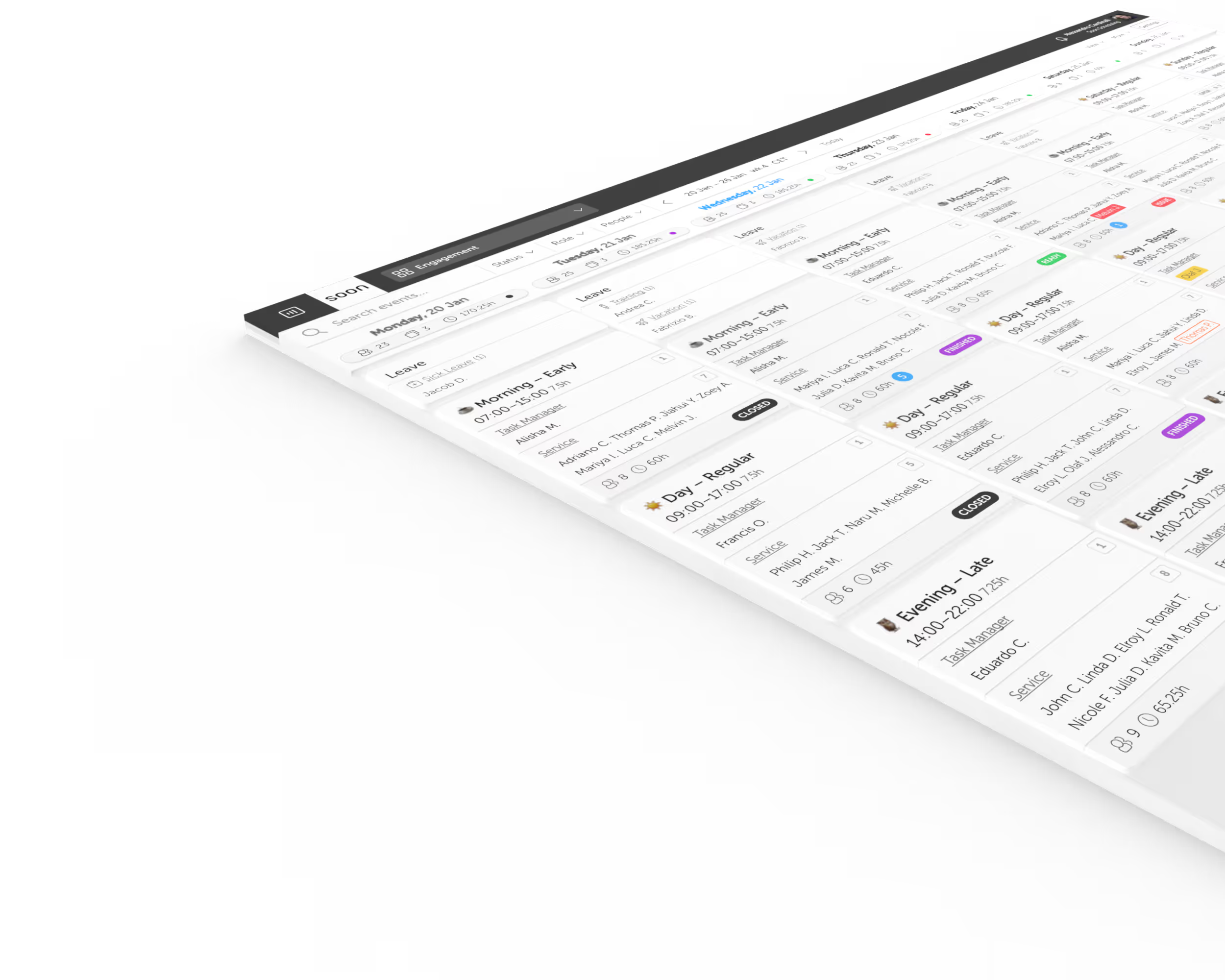
Your next schedule could take 2 minutes.

Import your team, set your rules, hit auto-fill. Most teams are live the same day.

Try Soon free

30 days free ยท No credit card required

Already have an account?Sign in