Excel, Whiteboards, and WhatsApp
How Fire Command Centres Are Still Scheduled in 2026 (and Why That’s Risky)
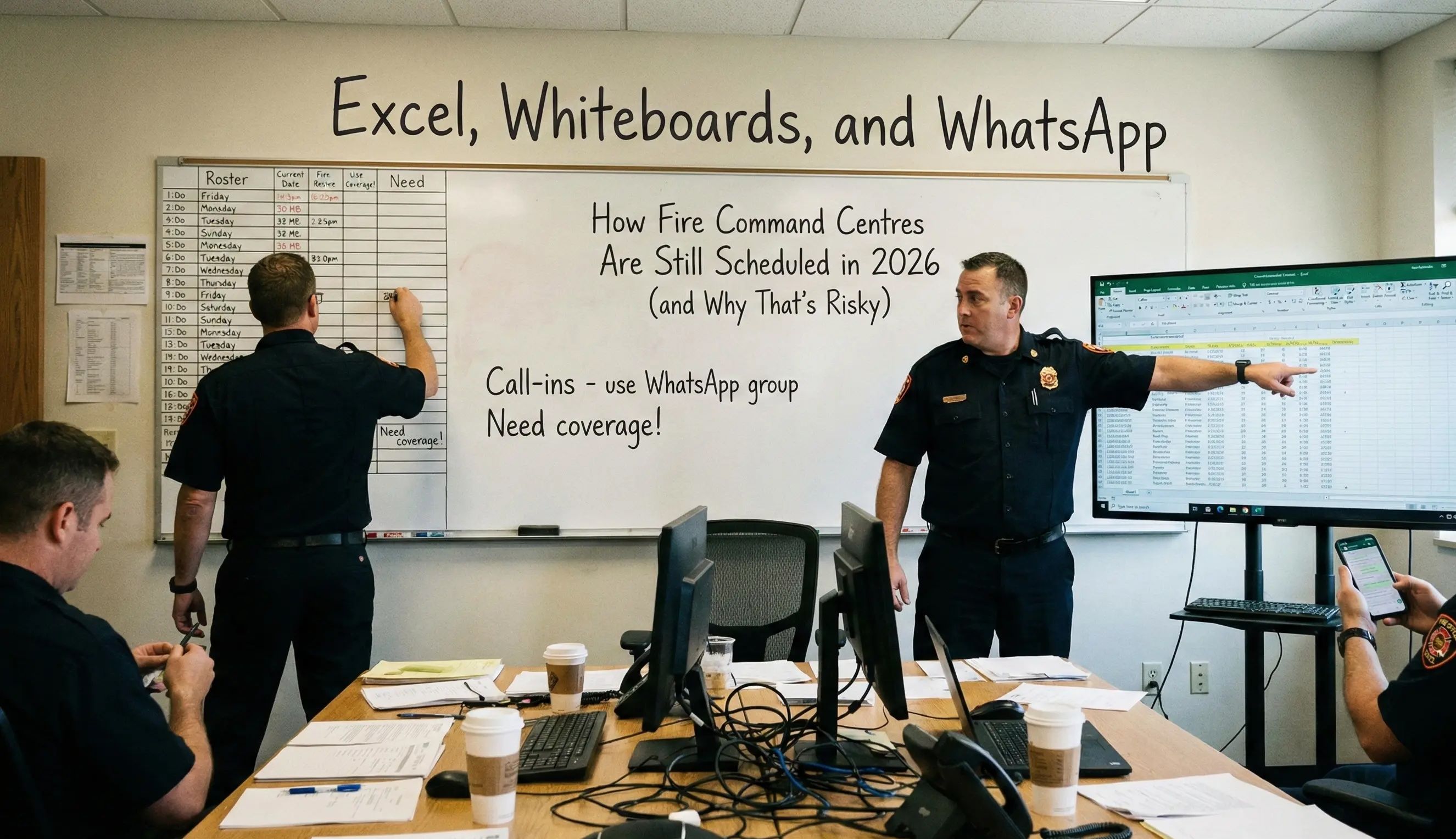
How Fire Command Centres Are Still Scheduled in 2026 (and Why That’s Risky)
Walk into almost any Fire Command Centre (FCC) in Singapore and you’ll see impressive hardware.
Fire panels. CCTV feeds. Building management systems.
Then ask a simple question:
“How do you schedule FCC coverage?”
The answer is rarely impressive.
What FCC scheduling actually looks like today
Across malls, office towers, hotels, hospitals, and mixed-use developments, the pattern is remarkably consistent:
- Excel as the master roster
- Whiteboards for day-to-day changes
- WhatsApp for shift swaps and sick calls
- Sometimes a PDF emailed at the start of the month
It works. Until it really doesn’t.
This isn’t because teams are careless. It’s because FCC scheduling is treated as admin work instead of what it actually is: operational risk management.
Why “good enough” tools survive in FCCs
Fire Command Centres sit in an awkward operational gap:
- Mandatory
- 24/7
- Regulated
- Quiet most of the time
As long as nothing goes wrong, spreadsheets feel acceptable.
But FCCs don’t exist for normal days. They exist for abnormal ones.
Where Excel breaks down in practice
Excel doesn’t fail when the schedule is created. It fails after the schedule is published.
1. Shift swaps erase reality
Someone covers a night shift. Someone leaves early. Someone switches informally.
The Excel file often stays unchanged.
Now there are two versions of the truth:
- the planned schedule
- what actually happened
Only one matters later.
2. Certification lives outside the roster
Not every guard is FCC-certified. Not every certification is still valid.
That information usually lives:
- in a separate file
- in HR
- or in someone’s head
At 03:00, none of those are reliable systems.
3. Fatigue is invisible
Night shifts followed by early mornings happen quietly.
On paper: compliant. In reality: risky.
Fatigue shows up as:
- slower reactions
- missed signals
- poor handovers
You won’t see that in Excel.
4. No defensible audit trail
When changes happen via messages or calls:
- Who approved it?
- When did it change?
- Who was responsible?
After the shift ends, those answers are gone.
That becomes a problem when questions come from auditors or regulators.
The hidden cost nobody budgets for
Most FCC budgets cover:
- headcount
- hardware
- inspections
- compliance certificates
What’s rarely budgeted for is ambiguity.
Ambiguity is expensive during:
- audits
- incident reviews
- internal investigations
- insurance discussions
Excel doesn’t feel risky day to day. It becomes risky retroactively.
Can you answer this today?
Here’s the real question:
If someone asked who was on duty, qualified, and compliant for any past shift, could you answer confidently?
If that answer depends on memory or message history, that’s a risk.
(2 minutes, no login required)
What better FCC scheduling actually changes
This isn’t about optimisation.
It’s about:
- one source of truth
- enforced coverage
- skill-aware scheduling
- logged changes
- history that doesn’t get overwritten
Less guesswork. More clarity.
Final thought
Fire Command Centres run worst-case scenarios on best-case tools.
If your FCC schedule lives across Excel, whiteboards, and WhatsApp, it’s not a question of if that becomes a problem.
It’s when.
Want to assess your FCC scheduling risk? Try the FCC Readiness Check →