Rotating Shift Implementation: How to Roll Out a Pattern That Actually Works
Learn how to implement rotating shifts with a clearer rollout, better pattern selection, and fewer problems around fairness, confusion, and exception handling.
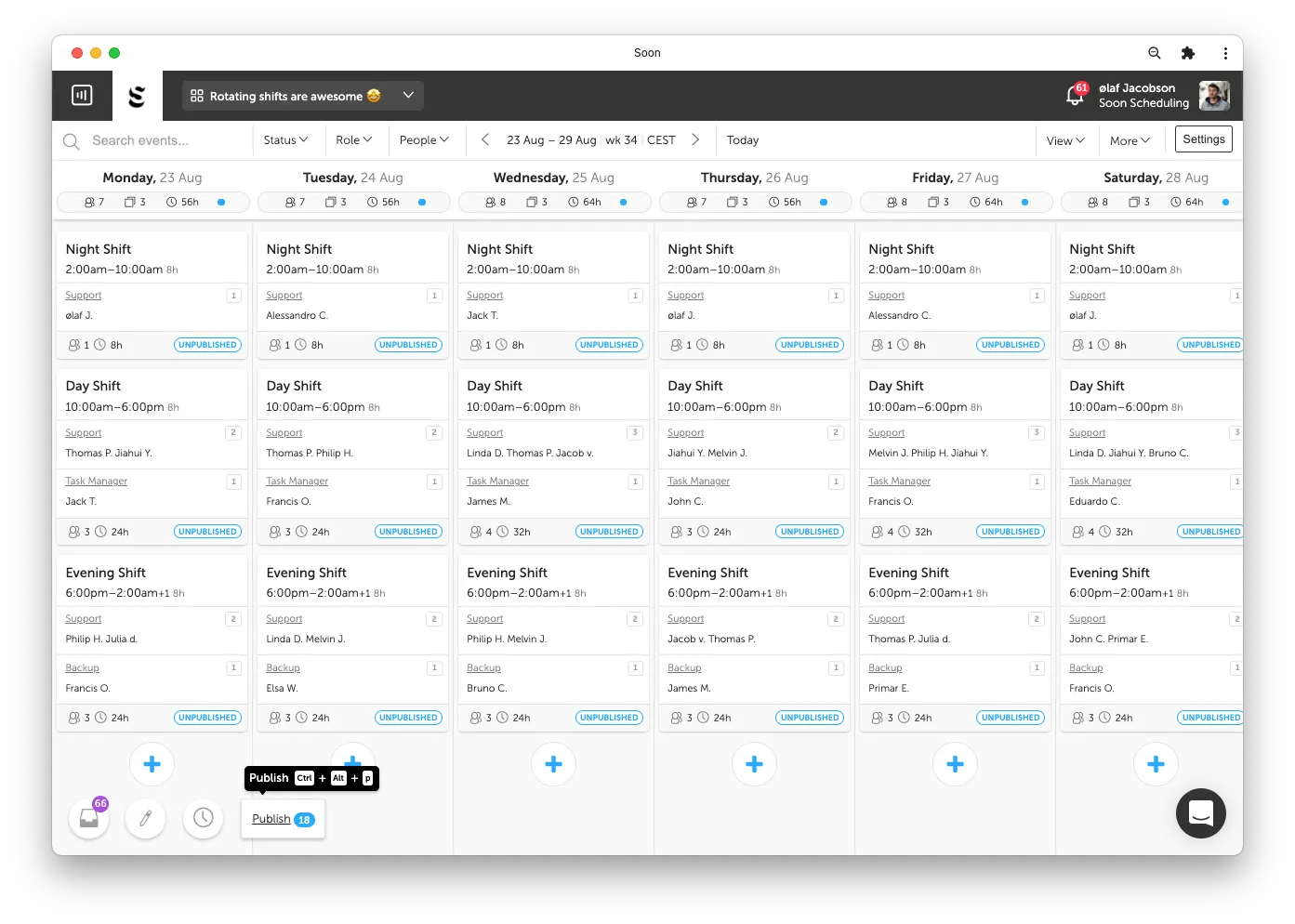
Key takeaways
- Rotating-shift implementation works best when the reason for the pattern is clear and practical.
- A strong rollout depends on understandable cycles, better transition design, and explicit exception handling.
- The schedule is not really implemented until it stays stable under real leave, swaps, and absences.
- Software helps most when it protects the pattern from drifting into manual repairs.
Implementing rotating shifts is not only about choosing a pattern and publishing it. The hard part is moving from a scheduling idea to a repeatable system that employees understand, managers can maintain, and the operation can trust under real conditions.
That is why rotating-shift implementation often succeeds or fails before the first cycle even begins. If the reason for the rotation is unclear, the handoffs are weak, or the team does not understand how the pattern works, the schedule quickly becomes harder to manage than the problem it was meant to solve.
This guide walks through a more practical implementation approach: when rotating shifts make sense, how to choose a pattern, what to test before rollout, and how to keep the rotation stable once normal exceptions start happening.
When rotating shifts are worth implementing
Rotating shifts are useful when a team needs broad coverage and wants to distribute less desirable hours more fairly. They are often a better fit than fixed shifts when the operation depends on evenings, nights, weekends, or repeated handoffs across the day.
- Use rotating shifts when fairness is a real issue: If the same people are carrying the hardest hours repeatedly, a rotation can spread that burden more evenly.
- Use them when coverage demands move across the week: Some operations need a pattern that shares responsibility for different windows instead of locking everyone into one fixed slot.
- Avoid them when the pattern adds more disruption than value: If the team gains little from rotation and loses predictability, a fixed structure may be stronger.
Choose the right rotating pattern before rollout
Implementation starts with pattern choice. Frequent rotations, slower rotations, and more custom cycles each create different tradeoffs around predictability, fatigue, and fairness.
Test the employee experience, not just the staffing map
A pattern can look balanced on a planning sheet while still being hard to live with. Review how often employees switch between shift types, how disruptive the transitions are, and whether the cycle is realistic outside the spreadsheet.
Check whether the cycle is easy to explain
If the team cannot quickly understand where they are in the pattern, implementation gets harder. Simpler cycles are often easier to maintain even when they are not theoretically perfect.
Account for known constraints early
Leave policies, training days, staffing minimums, role requirements, and rest constraints should all influence the chosen pattern before implementation, not after it.
How to roll out rotating shifts without confusing the team
Explain the reason for the change
Teams are more likely to accept a new rotation when they understand why it is being introduced. That might be fairness, broader coverage, better handoffs, or more reliable staffing across the week.
Share the cycle in a way people can follow
Employees need more than the next week’s shifts. They need to understand the pattern itself, what repeats, and where exceptions will show up.
Set expectations around requests and exceptions
Before rollout, make it clear how swaps, leave, and unexpected absences will be handled. If the team learns those rules only after the schedule starts changing, trust in the new system drops quickly.
What to test before implementation is considered stable
- Coverage quality: Does the rotation protect the most important periods well enough?
- Transition quality: Are people moving between shift types in ways that feel sustainable?
- Fairness over time: Does the cycle distribute burden reasonably across several rounds, not just one?
- Exception handling: Can managers absorb leave, swaps, and absences without breaking the pattern immediately?
- Team clarity: Do employees understand what they are working and where they are in the cycle?
A rotating schedule is not fully implemented when it has been published once. It is stable when those checks keep holding after real operational use.
How rotating-shift implementation fails
- The rotation is introduced without a clear operational reason
- Managers focus on shift counts but ignore difficult transitions
- The cycle is too hard for employees to understand
- Exceptions are handled ad hoc and slowly destroy the pattern
- Managers do not review fairness over time
- The workflow depends on spreadsheets and message threads to stay intact
What software should help with during implementation
Rotating-shift implementation gets easier when managers can keep the pattern, the exceptions, and the team communication inside one workflow instead of stitching them together manually.
- Pattern visibility: Managers and employees should both be able to follow the cycle clearly.
- Rule consistency: Hours, rest windows, skills, and role constraints should be applied consistently while the new pattern settles in.
- Leave and swap handling: These are often the first things that destabilize a rotation if they are handled outside the schedule.
- Adjustments without losing control: Managers should be able to correct the pattern without turning the whole system into one-off manual fixes.
That is why implementation often connects back to stronger shift scheduling and more practical rotating-shift management.
Final takeaway
Rotating-shift implementation works best when managers treat it as an operational rollout, not just a scheduling template. The right pattern, clear communication, and a workable exception process matter more than theory alone.
A good implementation should make coverage fairer and more sustainable over time, not harder to explain or more fragile to maintain.
If you want a more structured way to support that rollout, start with Soon’s shift scheduling product and the workflows that connect recurring patterns, schedule changes, and employee visibility.
Product
Explore Soon shift scheduling
See how Soon helps teams roll out and maintain recurring shift patterns with more structure.
Explore